Showing posts with label Buffalo Trl. Show all posts

Monday, May 23, 2016

Ash House Update

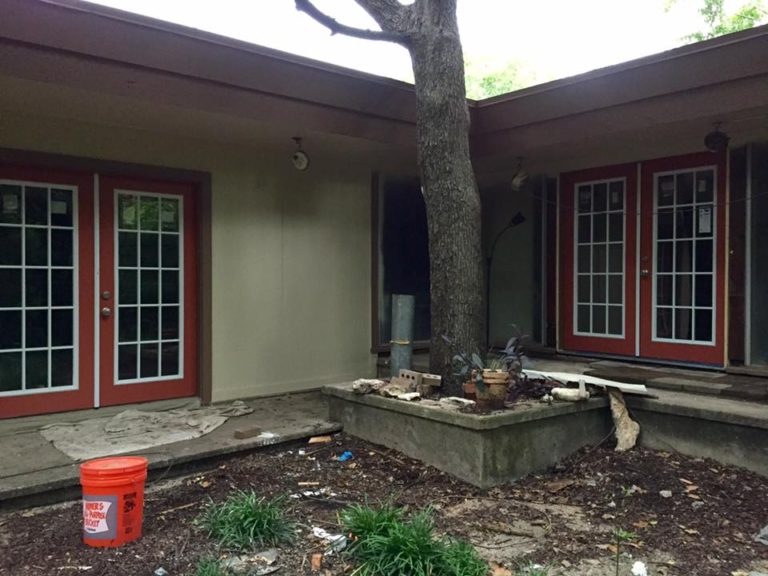
Front of the house, repainted and slightly landscaped. Mismatched chimney cleverly disguised by a tree.
Here you can see the three colors we are using. All from a Frank Lloyd Wright collection.
Back view, showing new doors, sparing you the sight of the actual yard.
This post originally appeared on the Hermit Haus Redevelopment website on 2016-05-16.
A group of us went by the Buffalo Trail house to check on the renovation work on Saturday. We even braved a flash flood warning to do so. Rehabbing is not for wimps.
All-in-all, I’m pleased with the progress the contractors are making on the place. They have the yard mostly cleaned up. That makes a tremendous difference when you consider how jungle-like the house was at purchase. If my kids were still kids, I’d no longer be afraid to let them play in the front yard. The back yard is still another matter.
Mowing the lawn did show how little grass grows under the dense canopy. So even cleaned up, the yard is still a little foreboding. We may have to put more effort into thinning the forest that we had originally anticipated.
The exterior brick has been power washed and painted—mostly. Thanks to the weather, the painter missed the chimney cap. The rains kicked in again about the time they finished painting the body of the house. So we have this reddish-brown chimney sticking out of a white roof on a gray house. Details. But the painter assures me it’s “on his list.”

Monday, May 16, 2016

Power Washing Cleans Up

Power washing the brick of your project can really make a difference in its appearance.
This post originally appeared on the Hermit Haus Redevelopment website on 2016-05-09.
I won’t be long today. This post is just a quick tip.
Power washing the brick of your project can really make a difference in its appearance. I know that sounds self-evident, but it’s easy to forget about because of that. Just look at the difference between the two shots of the Buffalo Trail house before and after power washing. I know these aren’t perfectly comparable pictures because we don’t have a continuity department tracking the angle of every shot we take. Still, I think you can get the gist. Power washing the brick and fascia prior to painting makes a big difference. On some projects, it may even be enough.
We’re not finished yet. We will paint the brick to give the house that elegant, modern feel. We’ll have more pictures when that’s done.

Wednesday, May 04, 2016

Everything Changes

There were three sliding glass doors in this project: one in the master bedroom and two in the family room. All will become French doors and picture windows.
This post originally appeared on the Hermit Haus Redevelopment website on 2016-04-27.
There is nothing so constant in this world as change…change and the value of collaboration.
We found out today that the walls we were planning to remove at the Ash House so we could “open up” the kitchen to the dining room are load bearing. The cost of engineering the LVLs to replace the walls and the delay in the project for engineers, permits, and inspection would cost more than we could expect to get from the change. So, we’re going to revise our thinking a bit and scale back to renovation instead of redevelopment on this project.
We’ll still have a really nice kitchen with a breakfast bar, just not the open concept we’d hoped for.
We have already removed the ugly and questionable built-in sideboard in the dining room, and we can still make better use of that space. We’re going to remove the (non load-bearing) wall that separated it from the shallow pantry to make a really nice pantry that will be accessible from the kitchen. From the dining room, the former sideboard will become a smooth wall. It will be a good place for an antique sideboard or maybe just some art.
Removing the plywood from the broken sliding door brought an amazing amount of natural light into the family room. We’ll replace all those sliding doors with French doors. In the family room, the two sliding glass doors will have one set of French doors and huge picture windows. That combination should let in as much light as the two sliding doors do now.
White roofs are more energy efficient, because they reflect back much of the brutal Texas sun.
As you can see from the photo, the roof is being replaced as I type. We went with a white shingle for aesthetics and to save on energy costs for our new homeowners.
The replacement windows are still about six weeks out. I’m glad we ordered them up front. The good news is that means we don’t have to spend time and energy masking or cleaning the windows when we paint the outside of the house. We’ll just paint the old windows and have a nice, clean look when we replace them.
All-in-all, we’re continuing to make progress. As with everything, flexibility is key. We’re not letting obstacles like load-bearing walls stop progress on this project. We’re being flexible and moving along. When we’re done, this will still be one of the nicest houses in the neighborhood.

Monday, April 25, 2016

Communication Is Key

About a week into demo, the front yard is still overgrown. It is also soaked from more than six inches of rain.
This post originally appeared on the Hermit Haus Redevelopment website on 2016-04-18.
I walked the Ash House with our partner Larry and one of Larry’s favorite GCs this afternoon. We had more than six inches of rain yesterday, so the yard was really wet. Unfortunately, the rain prevented us from getting started reroofing the house, which made a couple of leaks very apparent.
The meeting was to make sure all three of us are on the same page with regard to redeveloping the house. The contractor thought a couple of our ideas were a little extravagant, so he removed them from the original bid. We had to be firm that we really do want to open the kitchen up to the dining room and bring all electrical to current code. So please make sure there is money in the bid to cover it.
The GC has also found a couple of problems while demoing the bathrooms and kitchen. You never know what you will find when you open a wall. In this case, we found more work to do and more money to spend. But we will not sell a house we can’t be proud of. So our margins just got a little thinner. Here’s hoping they don’t disappear completely.

Friday, April 15, 2016

Builder's Risk Insurance

The backyard of the Ash House was grown wild for a number of years. I don’t think we can save the dog house, maybe the greenhouse.
The amount your builder’s risk policy will pay out in the event of a total loss varies with time (shown as weeks above), even if you insure (as I do) up to the full after repair value (ARV). Keep excellent records of what you have invested (blue line, shown in thousands of dollars) and how that investment affects the property value (orange line) to help get the most out of your insurance if you have to make a claim.
This post originally appeared on the Hermit Haus Redevelopment website on 2016-04-08.
We closed today on our joint venture project in Temple, TX. As you might guess from the last few blog posts, there were a number of last minute details to work out with the private money lender and title company. But we got them all done.
And I learned something about Builder’s Risk insurance in the process.

What Is Insurance?

Let’s start with an overview of what insurance is and isn’t. Insurance is a financial product where the insurance company agrees to indemnify you in the event of a loss. For insurance to work, three conditions must be met:
  • You have to feel there is sufficient risk to justify paying for the policy. (In redevelopment, there always is.)
  • There must be a sufficient number of policy holders that need the coverage to interest the insurance company in writing the coverage.
  • The insurance company must believe there is a profit to be made by indemnifying you, generally by spreading the risk over the “pool” of insureds.
Like the name implies, with buider’s risk the insurance company agrees to indemnify the builder (you and me) against specific types of loss during the process of building or remodeling a property. The word “indemnify” screws up many people. All it means is that the insurance company will pay you a specific amount of money if you suffer harm or a loss, up to the maximum coverage. That is, the insurance company will make it financially as if the loss never occurred.

What Will It Pay?

The question that makes builder’s risk insurance interesting is, “What is the amount of the loss?” You suffer less damage if a tornado levels your project the day before you start redevelopment than if the same thing happens the day after you complete it. And it is different on any day between those two points. I’m using a tornado in this example because a total loss is much easier to define than a partial loss, such as a minor fire.
So let’s say you bought a house for $70,000. You expect to spend another $70K redeveloping it over the next 60 days. When you’re done, you expect the house to be worth $180K. The beginning and end points are fairly clear. If the tornado happens on day one, the insurance company would pay you about $70K. If it happens after completion, you could justifiably expect (but might not receive) $180K.
But the amount of harm you suffer would vary at any point along the way. Let’s say you spent the first week cleaning up a jungle that had grown around the house. You spent $2K. That investment might not be counted a loss because it wasn’t spent on the structure. But if you spent $8K replacing the roof the next week, you have improved the value of the structure by at least $8K. The insurance company would probably pay you at least $78K of the $80K you have invested.
The same holds true for demolition costs. Do they actually increase (or possibly decrease) the value of the property and, therefore, the amount of loss you suffer? You could argue that you’re still out the money for demolition, and you’d probably win, but….
Document everything!Image by Bitmoji
What the insurance company pays in the event of a loss depends on the amount you have invested and the actual loss you suffer. Both of these depend on you keeping squeaky clean records with receipts and all sorts of other documentation. I wouldn’t expect the insurance company to cover anything over your actual costs unless the project is complete or so close to completion that you are actively marketing it. Even then, it depends on how your policy is worded.
The take-aways:
  • Always carry builder’s risk insurance on your redevelopment projects.
  • Make sure you understand how the insurance company will determine the value of a loss before you sign the contract.
  • Document everything.
  • Don’t expect the insurance company to pay more than you can prove you’ve spent.
The first three of these take-aways hold true even if you are a regular homeowner instead of an investor. Then the last one that the insurance company probably will not pay more than actual market value, no matter what you think you home is worth. They have not emotional attachment to it.

Caption Photo by: Suna

Tuesday, April 12, 2016

Entrepreneurial Blues

A good entrepreneur finds balance. Image by: Bitmoji
This post originally appeared on the Hermit Haus Redevelopment website on 2016-04-05.
Warning: This post can be construed as whining. If I hadn’t promised to be as honest as possible about our journey, I wouldn’t post it. It sounds like whining to me, and I don’t like whining. Feel free to skip it. But if you want to know what it’s really like to run a small real estate redevelopment company, I guess I’m writing this for you.
When you’re getting started—and possibly even after you’ve been doing redevelopment work for awhile—you don’t have a huge staff to rely on. Some of the many tasks required to keep a company like this one working include but are not limited to the following (presented in no particular order):
  • Finding money
  • Budgeting
  • Plowing through the MLS
  • Prospecting for buyers, sellers, contractors, handymen, etc.
  • Reviewing contracts
  • Signing contracts to buy, sell, and finance projects
  • Keeping the books
  • Finding money
  • Monthly, quarterly, and annual financial reporting
  • Paying contractors, assistants, lenders, suppliers, etc.
  • Communications (blogging, Facebook posts, one-off letters, advertising, etc.)
  • Marketing, marketing, and marketing
  • Crunching numbers
  • Estimating repairs
  • Finding just the right wine
  • Finding money
  • Managing contractors and vendors
  • Setting policy and defining procedures
  • Negotiating with buyers, sellers, contractors, suppliers, etc.
  • Record keeping (physical and electronic documents like permits, licenses, contracts, etc.)
  • Envisioning, inspiring, and directing operations
  • Finding just the right whine
I believe in job creation, but I also believe in profits. So there are only four of us working on this enterprise, and we each have unique roles and skills. To oversimplify: Russell works on finding deals and keeping the back-end systems running. Carol is our real estate guru; she keeps all of our preliminary numbers realistic, is our numero uno marketeer, and manages projects. Sue Ann is our social media expert, editor in chief, and networker. That leaves most of the boring business stuff to me. I love what I do, but...whine!
We do have assistants—virtual and otherwise—who handle most of our secretarial work: printing, copying, and mailing marketing materials. But the other listed tasks (and many, many more) fall to one of the four principle investors.
What set off this whine-arama is that I spent almost my whole day for the last two days chasing down random bits of paperwork for lenders and title companies involved in two of our current projects. In a perfect life, this would have been work I delegated to a file clerk. Unfortunately, I am the file clerk (technician level, in Kiyosaki’s quadrants).
Now you learn in investor school to prepare for this by keeping the most commonly needed documents in a folder on your desktop. This I do. However, each transaction we do adds to that list of documents. My “Commonly Needed” folder now runs just over 8MB, compressed. I’m waiting for some bank or title company technician to balk at looking though it and ask, “Why don’t you just send me the documents I need?” But so far, they always find just one more document to request.
My advice: Keep smiling and telling yourself it’s all a brilliant learning exercise that you’ll get through and eventually have it all down and a staff to delegate it to. That or learn to “play the guitar on MTV.”

Wednesday, March 23, 2016

How the Win-Win Creates Wealth

Larry, Lee, Sue Ann, and Valerie at an event in Houston. If you live life with a service mentality, everyone you meet is your partner.
Sometimes despite best intentions, rehabilitating your house turns out to be more than you are up for. We can help.Dominic’s company found a very sad house in one of the best neighborhoods in Temple, but it was too far north for them to manage the redevelopment. So they sold the contract to Hermit Haus and made a tidy profit on the deal!
This post originally appeared on the Hermit Haus Redevelopment website on 2016-03-16.
We at Hermit Haus Redevelopment focus on finding situations where everybody wins. I’m often asked how that can work. “Doesn’t somebody have to lose out?”
The answer is that not everybody measures their success in financial terms. When my mom died, Dad just wanted out of a house with too many memories. When he sold it for 70% of what it was worth in its as-is state, he was ecstatic to be free of it. He could put money in his pocket and start living life on his own terms.
Here’s how a group of people can work together to improve a neighborhood, create wealth, and build a situation where everybody benefits:
  • I will admit that I wasn’t involved in the original transaction. So I don’t know what the original seller’s motivation was, but I’m going to assume their best interest was served by selling a house that was too much for them to renovate for sale. Maybe, like my dad, they were happy to sell the house for more than they paid for it, even if it wasn’t what it would have been worth if they worked to rehabilitate it.
  • Another redeveloper Larry met at the Houston Summit last month is financing the project in return for two points (2% of the money he’s lending) plus 12% APR on the note.
  • I put the project together, will manage the finances and be responsible for the mortgage, and will front most of the renovation budget not covered in the initial mortgage. In return, Hermit Haus will retain half of the profit at sale.
  • Larry’s contractor friend will do most, if not all, of the work—or rather, his company will. He will retain a fair profit on what currently stands at a $70K redevelopment budget while his employees benefit from a living wage.
  • Larry’s company is responsible for managing the day-to-day operations of the redevelopment project. It keeps the other half of the profits at sale.
  • The neighborhood where the house is located gets a nice home where there is currently an eyesore that isn’t currently habitable. Everyone’s property values should increase as a result of this project.

Friday, March 18, 2016

Number Three

Temple (magenta circle) is pretty far north of Hermit Haus’s focus area (magenta glob).
 
Here is the house with the pile of ashes featured.
This post originally appeared on the Hermit Haus Redevelopment website on 2016-03-11.
My mentor Phill Grove always says, “Your Net Worth equals your NetWork.” Here’s an example.
A few days ago, I got a call from Dominic G, another redeveloper working in Central Texas. He was checking references on a General Contractor with whom I’ve worked for many years. As we chatted, we found out we have a lot in common, including the back office system both our companies use. Then Dominic mentioned he had a house under contract in Temple. Since Temple is well outside of his normal range of operations, he wanted to know if I would be interested in buying the contract from him.
Now Temple is also pretty far north for Hermit Haus to go. We don’t usually get much farther north than Georgetown. But the numbers looked good on the surface, so I said I was.
Last month, I met yet another redeveloper at the Houston Summit who has done roughly 20 houses over the last 20 months in the “Greater Temple” area. We’ve been chatting a bit, so I called Larry and asked if he’d like to JV (form a joint venture) with Hermit Haus to get the deal done. He did. We did an onsite evaluation with Larry’s lead contractor, revisited the numbers, and came to an agreement on how to proceed. Hermit Haus is now under contract to buy its third house since December.
We’re calling this project “The Ash House” because the previous occupants appear to have heated the house with a lovely wood-burning fireplace for several years. Unfortunately for the neighbors, they just dumped the ashes in a flowerbed until the pile is at least 36 inches tall and a couple of feet in diameter. One of the first items to clean up on the list!
Everybody wins!