Showing posts with label book review. Show all posts

Sunday, August 05, 2012

Writers Unaware


Card, Orson Scott, and Aaron Johnson. Earth Unaware: The First Formic War. New York: Tor, 2012.Cover courtesy of Library Thing

As a long-standing fan of both Orson Scott Card and the Ender series, Earth Unaware was a heartbreaking disappointment. Delegating a beloved series seldom works unless the primary author's goal is to kill off that series. If that was the goal, Earth Unaware is a resounding success. If I were not already aware of Card's brilliance, I would never attempt another book in the series. In deed, if not for the misguided belief that “the whole thing can’t be this bad,” I would never have finished this….

Aaron Johnson states Earth Unaware evolved from a comic book project to provide backstory for Ender’s Game. Unfortunately, the book does not make it past the comic book level. In fact, it is not so much a novel as an extended slice of life that rambles form the Kuiper Belt to Earth’s moon with only a vague sense of direction. There is a saying among writers: “Novels are never completed, only abandoned.” EU was not abandoned; it was amputated.

Worse, the two collaborators never achieve a common voice. They do not even seem to be telling the same story. One (I assume Card) paints detailed technical panoramas in smooth technical prose. The other vainly attempts sophomoric character interactions that are as shallow and moving as a mosquito bite using descriptions dictated by a Flesch-Kincaid algorithm. Perhaps this level of character development is appropriate to a comic book. It is too banal for a novel. I frequently found myself skimming/skipping any number of pages until I found another section where I would be drawn back into the story rather than bludgeoned with sixth grade sentimentality.

The collaborators compensate for this failure somewhat by switching character perspective, but the stylistic dissonance continuously knocked me out of the story. When writers force the reader to think about style, they fail to create the illusion of the universe they are trying to build. Few writers are stylistically brilliant enough that linguistic excellence is its own end. Neither collaborator achieves such stratospheric writing in this book.

Further, I could not believe in any of the characters, except Concepcíon, the free minor ship captain. She was the only character in the novel capable of demonstrating character. For all the others, we were simply told they had character, what I call the Republican approach to character development.

I can say this much positive about First Formic War:

  • Card’s explanation of the technology underlaying the characters' lifestyle was clear, intriguing, and unobtrusive.
  • The book inspired me to take Suna shopping for bath towels—I think primarily as the escapist activity I had hoped the book would provide.

Saturday, July 17, 2010

Book Review: Abraham Lincoln: Vampire Hunter

Image Grahame-Smith, Seth, (2010). Abraham Lincoln: Vampire Hunter. New York: Grand Central Publishing. Photo source: Amazon.com

Until I read Abraham Lincoln: Vampire Hunter, I hadn’t realized how much the readability of Seth Grahame-Smith’s previous book, Pride and Prejudice and Zombies, was derived from the original. While I admired the near seamless integration of zombies into Alcott’s social commentary, I considered the result more of a collaboration than an outright theft.

In Lincoln, Grahame-Smith attempts an interesting technique. After setting up the situation where a failed writer—how’s that for another cliché?—comes into possession of Abraham Lincoln’s secret diaries, Grahame-Smith randomly switches voice and often tense by inserting sections from the diaries into his narrative. The result read like a tenth-grade history paper in which the author is desperately trying to meet the teacher’s length requirement. Instead of abetting the flow of the story, the device constantly knocks the reader out of the story.

Character development is lacking. Who would have thought anyone could depict Abe Lincoln as a flat, uninspiring character. If that was Grahame-Smith’s intent, he succeeded.

One of the best things I can say about the book is that I found no glaring grammatical errors and no blatant historical inaccuracies. Aside from vampires, and they are a given.

I can’t say if this is a good thing or not, but I was completely unable to categorize Lincoln, not that I’m a true believer in forcing art to fit into neat little boxes. Lincolnis not a vampire story, nor is it really historical fiction. It is neither folkloric nor alternative history, neither enthralling nor fatiguing.

None of this is to say you shouldn’t read Lincoln. It is a quick read and fairly entertaining. It passes my three question test.

Did I finish it?
Yes. This, in and of itself, speaks volumes. I don’t have much time to read for pleasure anymore, and I stuck with this book to the predictable end.
Was it worth the effort?
Maybe. As I said, it is a quick, relatively entertaining read. Granted, it feels like Lincolnwas written before P&P&Zand was published solely on the success of that book.
How many other books did I finish in the process of reading this one?
None. I did wander off into a couple of real histories—but they were only a minor distraction

Using a five-star scale, Lincolnrates a solid two stars. It’s worth reading in an airport or on a train, but save it for a trip.

Monday, June 14, 2010

Book Review: Brains: A Zombie Memoir

Image
Becker, Robin (2010). Brains: A Zombie Memoir. Oxford Oxfordshire: Oxford University Press. Cover Courtesy of: Harper Collins, Canada

Robin Becker’s first novel Brains: A Zombie Memoir stands the zombie genre on its ear. Literally. The ear happens to be on the ground, and the zombie stands on it before popping the tasty morsel into its mouth.

Becker anthropomorphizes zombies in Brains. Her main character is a professor of literature who retains his sentience through the transformation. Granted, I’ve known several professors whom I thought might be zombies, but the only one I was sure of was a civics professor.

Once she makes this single break from the genre cannon, all bets are off. Becker writes in a morbidly campy style that she admits is unlike anything she’s done before. Brains is a light, enjoyable read full of snickers and an occasional belly laugh.

The only negative is that Becker sometimes tries too hard to make her jokes work. She stacks the one-liners four or five deep, oblivious to Johnny Carson’s rule—Never do more than three jokes on a topic. Perhaps this is a lesson to learn from her first novel; perhaps it is simply the professor’s character. I have known several who couldn’t leave well enough alone.

Wednesday, October 29, 2008

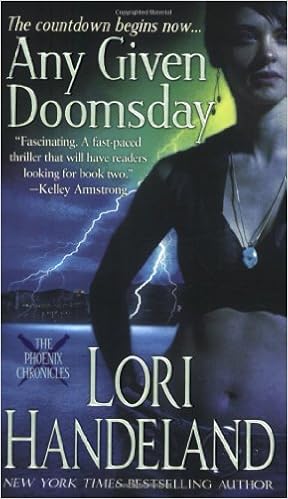
Book Review: Any Given Doomsday

Buy the book on Amazon. Handeland, Lori (2008). Any Given Doomsday. New York: St. Martin’s Paperbacks. Photo source: Amazon

Any Given Doomsday is an urban fantasy novel about an ex-cop turned bartender named Elizabeth Phoenix, who is also a psychic. This is the first novel in a series to be called The Phoenix Chronicles. (A scene from the next book is even included as a teaser.) “Chronicles” seems to be the current word in fantasy to indicate a series.

The book is a fairly quick read, and it held my interest. While it did not keep me up nights reading, I wanted to pick it back up every time I laid it down. Even so, the style is distracting. It reads more like a 1940s private investigation novel. It’s a lot like reading an old Mike Hammer novel—but with vampires, werewolves, magic, and lots of graphic, gratituitous (if not very erotic) sex.

In short, Doomsday is a good book to pass a few hours with. It’s not high art, but it doesn’t pretend to be. This book does not take itself too seriously, and you shouldn’t either. Just relax and enjoy the ride—if you can.

Wednesday, September 17, 2008

Book Review: The Film Club

Gilmour, David (2008). The Film Club: A memoir. New York: Twelve.

Photo source (and another good review): Zawan

David Gilmour is a Canadian writer and film critic who shares a name with the guitarist for rock legend Pink Floyd. The Film Club is a memoir about a deal he made with his son and an unusual home-schooling strategy. Gilmour allows his son to drop out of school with caveats:

  • They will watch a minimum of three movies a week together. (Gilmour is unemployed at the time.)
  • All bets are off if there is even the hint of drug use.

Some of the reviewers on LibraryThing seem a little dismayed that a noted film critic could write a whole book without discussing a single film in depth. But this book is not about the films they watched together—the discussion of the films serves only to illustrate Gilmour’s teaching method, not as an exhaustive curriculum or instructional paradigm— it is about the relationship that develops between a father and son as they explore life. It is about being there for your kid, something I was not that good at. It is about winning by losing, holding on by letting go, and learning through freedom.

The strength of the book is that Gilmour does not gloss over his own misgivings or mistakes. Nor does he hide the bad choices his son Jesse makes. This is an honest, at time brutally so, tale of growing up and making choices.

As an instructional designer, I believe that we learn more from our mistakes than our successes. Gilmour had the courage to allow Jesse to make mistakes and to provide only enough of a safety net to help the boy survive them. That isn’t an easy path to follow in a classroom full of strangers, and it would be that much harder to follow with your own offspring. I would not have been able to.

Gilmour’s choices are not for everyone. Jesse’s choices, good and bad, are similar to those made by many young people. The book is the story of how they come to survive together and Jesse learns to stand on his own. It is well-written and hard to put down.

Sunday, September 07, 2008

Book Review: I, robot [sic]

No larger image available.
Smith, Howard S. (2008). I, robot [sic]. Toronto: Robot Binaries & Press.

Photo source: LibraryThing

I, robot has nothing to do with the Isaac Asimov classic of the same name or the movie that devolved from Asimov’s collection. (I wonder if the lower case r in the title is an oversight, an futile attempt to make the title seem original, or just an attempt to convey something in a manner so oblique that the meaning is lost. According to reviewer notes in the advanced copy I read, the publisher seems to have chosen the title and based on the robot-like qualities of the lead character who suffers from obsessive-compulsive disorder.

Smith’s I, robot reads more like Tom Clancy than Asimov. Its short chapters make it a deceptively quick read. It seems that every time the author would have inserted a subchapter break, he simply made it a new chapter. This technique does not make the book too choppy for me, but it may bother some readers. Rather, I see it as an attempt to keep up with the attention span of many of today’s readers. The book is chunked like a technical manual, which it may turn out to be.

One thing that did bother me was the amount and quality of illustration. While the maps were useful, most of the drawings did little to supplement the text. They served simply as decoration, in case you had trouble processing text at a fifth-grade reading level. Worse, some of them seemed to be used more than once and thrown in randomly to boot.

Smith is an engineer and, unusual as it seems for that profession, a pretty good technical writer, so you won’t find any awe-inspiring phrasing or poetic language. The characters are not very well developed, and almost all of them seem robotic. The plot has no unexpected twists and often bludgeons you with predictability. But Smith pays attention to the story and keeps it moving, even if he overuses deus ex machina when he writes his lead character into a corner.

I, robot is like a shortbread cookie. It might help you stop a craving, but it won’t satisfy the underlying hunger. You’ll still have to look elsewhere for real satisfaction. But if all you want is a way to kill time in an airport, this is a good choice. You can put it down and not worry whether or not you find your exact spot when you pick it back up. If you don’t pick it back up, you won’t spend the rest of your life wondering what happened to the characters; they won’t mean that much to you.

Friday, August 29, 2008

Book Review: Misquoting Jesus

Image
Ehrman, Bart D. (2005). Misquoting Jesus. San Francisco: HarperSanFrancisco.

Photo source: LibraryThing

Misquoting Jesus is the most cogent book on the Bible I have ever read. Bart D. Ehrman began his study of the bible as a newly-reborn evangelical Christian. His intellect soon led him to conclude that we can’t treat the Bible as the word of God unless we know what the actual words were.

This quest lead him to learn the ancient languages of the original texts. In so doing, he noticed what others, going back to before King James, had: that the texts differ—sometimes significantly—in terms of the actual words used and sometimes in actual meaning. By 1707, John Mill had identified more than 30,000 discrepancies. Today, that number exceeds 200,000.

But the strength of Misquoting Jesus derives not from an exhaustive list of discrepancies, but from the all too human story of how these discrepancies came to be. For example, myth holds that King James Bible was translated into English based on original Greek manuscripts. Not only were the “original manuscripts” nonexistent, the text used for translation was a collection of manuscripts that just happened to be in Western Europe, where Latin text, not Greek, had been collected. In a rush to press (to beat the official Catholic Church collection to the market), at least two of the books of the New Testament were translated into Greek from Latin texts at hand.

But Ehrman goes even further back, explaining how some of the changes and additions to the texts were used to further the theological, social, or political aims of the editors, while others attempted to resolve discrepancies between different authors or were simply transcription errors. In the examples and explanations, Ehrman provides an overview of textual criticism—the logical search to find the original words of the author by comparing derivative editions.

Misquoting Jesus is a fascinating read. I used an entire pad of sticky notes marking passages and highlighting key concepts. This book really deserves to be a best-seller. If you haven’t read it yet, you should, no matter what your religious orientation is.

Thursday, August 14, 2008

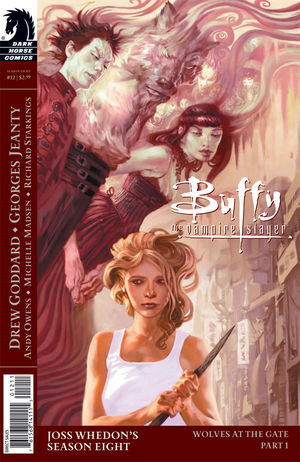
Book Review: Wolves at the Gate

Image Goddard, Drew (2008). Wolves at the Gate: Buffy the Vampire Slayer Season 8, Issue 3. Cover source: Dark Horse Comics
Andrew: Oh, hi, Buffy. Hi, nude Asian girl…. How much Dramamine did I take?
—Drew Goddard

Wolves at the Gate comprises issues 12–15 of Season 8. As of this writing, it has not been reissued in book form, but that is only a matter of time given the previous history of this series.

Wolves returns the focus to Buffy, but it still feels like an arc device. That is, its main purpose seems to be to move the season along rather than to stand on its own. When BtVS was on the air, each season always included at least one show so dedicated. While important to the season, they were never very satisfying.

Wolves is an improvement on these other arc devices in that it provides a look at new facets of Buffy’s character. It also provides some insights into the relationship between Xander and Dracula, who appears to fight on the side of the slayers out of personal vanity because a group of upstart vampires in Tokyo have stolen some of his powers.

But Drew Goddard is what really separates Wolves from previous arc devices. He brings the wit and humor that characterized the series to the comic form. The writing is superb, making us fall in love with the characters again. What this episode lacks in plot, it more than makes up for in character development. Maybe, it isn’t just an arc device after all. Read it and decide for yourself.

Sunday, August 03, 2008

Book Review: From the Dust Returned

Book Cover. No larger image.
Bradbury, Ray, (2001). From the Dust Returned. New York: William Morrow.
Photo source: LibraryThing

Like many of Bradbury’s “novels,” From the Dust Returned (hereafter referred to simply as Dust) began its life as a collection of short storied, most of which date from the 1940s. Most of these short stories are quoted in their entirety, becoming a “chapter” in the “novel.” I quote the words novel and chapter when applied to Dust because it is simply another short story collection bound together by a tenuous story line inserted as an afterthought and declared a novel.

Bradbury has never made any pretense of being anything other than a writer of superb short stories. He readily admits that his first novel, the classic Martian Chronicles, was simply a collection of unrelated short stories that shared a common setting. He repackaged these stories to get a publisher who demanded a novel to accept them.

Dust follows this tradition. Much of the book consists of a series of esoteric short stories that are really more word paintings than stories written in the 1940s, I assume the publishers were buying only two words in the stories: Ray Bradbury. The rest of the book consists mainly of new word paintings that tie the older stories together and provide a semblance of plot. Bradbury’s style is such that I couldn’t sort the older stories from the newer ones without consulting the acknowledgments.

Many of the transitions are abrupt, flinging the reader haphazardly from one frame of the comic to the next. But Bradbury’s eloquence quickly sooths any jangled nerves.

Now, there were times I was tempted not to pick the book back up. (Indeed, I may have set it down the first time I tried to read it; I found a bookmark a little more than half-way through.) If you’re looking for one of Bradbury’s more accessible works—say Fahrenheit 451 or Something Wicked This Way Comes, look elsewhere.

You should read Dust for the beauty of Bradbury’s language. Bradbury is a word painter who creates dramatic scenes in the reader’s brain though his mastery of poetic language. In rereading this work, I didn’t care that there is no real plot to follow. Neither did I care that the characters are mostly flat—more line drawings than portraits. Bradbury’s language is its own reward. It doesn’t knock the reader out of the story because there is no story, only flowing, beautiful language. Just make sure you’re in the mood for that kind of book before you pick this one up.

Friday, August 01, 2008

Book Review: The Informed Gardener

Image
Chalker-Scott, Linda, (2008). The Informed Gardener. Seattle: University of Washington Press.
Photo source: LibraryThing

Linda Chalker-Scott makes it clear that all content in The Informed Gardener is available for free on her web site. She published the book only as a convenience for those who wanted to read her previous articles in book form. Frankly, I’m glad she did. I probably would never have found this wealth of information otherwise.

Chalker-Scott writes in a clear, down-to-earth style that conveys useful information to people who intend to use it. She organizes her columns (chapters) in the form of common gardening myths to be busted. And bust them she does. For example: she states that long-term research shows that transplanting trees and shrubs bare-rooted is much more effective than leaving the root balls undisturbed. She also shows that the people who most often tout the benefits of emending lawn soil are the people who sell the emendments. Interesting, huh?

Every serious gardener—and those of us who are only passing serious—needs a copy of this book.

Friday, July 18, 2008

Book Review: The Thirteenth Tale

Image
Setterfield, Diane, (2007). The Thirteenth Tale: a Novel. New York: Washington Square Press.
Photo source: LibraryThing

Diane Setterfield’s The Thirteenth Tale is the first book in ages to keep me up nights reading. And it is an unlikely candidate for this honor. It is a woman’s book, and all the important characters are women.

The story centers on the unlikely friendship of two women: one, an elderly grand dame of British writing; the other, a bookshop dweller who is hired to write the older woman’s biography. Margaret Lea, the bookshop maven and narrator, leads a life I would dearly love. She live above her father’s bookshop, reading whatever she wants, whenever she wants. If there were only room for gardening. But there is!

The violence that often drives plots is buried in the distant past, glimpsed only gradually—as if to give you time to become accustomed to it. Like all good Gothics, this novel is replete with British aristocracy, wealth, decay, depravity, and true love—although the later is found in unlikely places.

But mostly, it is the language that enraptures. Setterfield does not make the mistake of many writers who use beautiful language. Her eloquence never knocks you out of the story. Instead, her natural rhythms and distinctive voices only enhance the story, drawing you deeper into it from the first word. Then she uses language to ease you back into “reality” rather than leaving you hungering when the story ends.

Wednesday, July 09, 2008

Book Review: Initiation

Cover
Haich, Elisabeth, (2000). Initiation. Santa Fe: Aurora Press.
Photo source: LibraryThing

Initiation is a strange book. A novel set as an autobiography of a bodhisattva, it hits all points of the readability spectrum.

  • The description of life through a child’s eyes is captivating and humorous. I loved this child and could not put the book down during this phase.
  • The adolescent girl really annoyed me, again capturing the self-centeredness, depth and shallowness of adolescence. I did not like the character very much at this point, but I wanted to see her grow up.
  • Unfortunately, by the time the novel describes the woman as a young adult, the author devolves into preachiness. I no longer cared about the character because she flattened out, becoming a mere tool for a message spiritual message Haich wanted to convey.

While dialog was never Haich’s strong suite, when the character enters adulthood, conversation becomes stilted. The plot sickens, and the author falls into preachiness. I put the book down one night when I got sleepy—once the character became an adult, it becomes very easy to put the book down and go to sleep—and I haven’t been able to make myself pick it back up again.

It is sad that this was Haich’s only work of fiction. This novel shows her potential. Writers aren’t supposed to reach their potential with their first novel. Unfortunately, Initiation was published six years after her death.

Wednesday, June 11, 2008

Book Review: No Future for You

Book cover Vaughan, Brain K. (2008). No Future For You (Buffy the Vampire Slayer Season Eight, Volume 2). Milwaukie, OR: Dark Horse.
Photo source: LibraryThing

No Future for Youcompiles issues six through nine of Season 8 . It tells the story of Faith as she tries to redeem herself by taking an assassination assignment. The writing is good, and Faith’s character develops nicely within the parameters already established while BtVS was on the air.

Giles’ character also undergoes a couple of predictable, if unexpected, twists. Buffy and the other members of the Scooby Gang, however, remain on the periphery and relatively flat.

I enjoyed rereading the set with the acquisition of this volume. Buffy fans should consider it, although I wouldn’t call it a must-read.

Saturday, June 07, 2008

Book Review: Buffy Omnibus Volume 4

Omnibus, volume 4 (O4) is the best of the series so far. The writing is much close to the quality I came to expect from the series, partly due to the inclusion of the 19-issue, 200-page “Bad Bood” by Andi Watson, who has written the scripts for several graphic novels in the Buffyverse.

But the overall writing is better than the previous volumes. There were times in the first three volumes when I had to make myself continue reading. In O4, I had to make myself stop. Even the supplemental stories were well crafted.

And this volume ties in nicely with Season 3 of the TV series. The characters are more consistent with the series, and the action fits nicely in between the cracks of the season. For Buffy fans, volume 4 is a must read.

Wednesday, May 07, 2008

Book Review: The Quickening

Image
Photo source: Library Thing

This post concludes my second and final attempt to read The Quickening. This time I made it almost half-way through. I barely finished the first chapter on my first attempt. While Bell is one of my favorite late-night loonies, his rambling, disorganized style is much better suited to radio at 2AM than print.

Note: “The quickening” has nothing whatsoever to do with highlanders, immortals, or swords.

It doesn’t help Bell’s case that I am reading about his prognostications a full decade after publication, but the predictions are so whack that I probably would not have been able to finish this book had I read it when it was “fresh.” Bell’s thesis seems to be that the future is happening faster and faster, that the world is developing a global economy, and that nobody is in control. Tell us something we didn’t already know years before you wrote this book, Art.

Saturday, April 26, 2008

Book Review: Isolde, Queen of the Western Isle

I said I would post more, but then I got sick. One good thing about being sick is that I actually had time to read a book, even if it was a very quick read.

Isolde is a well-crafted book that is good for a day’s diversion. Set in the reign of King Arthur, it dances on the periphery of Camelot. It is a tale of predestined, if star-crossed love that is helped along by simple-minded aristocrats and magical beings alike. I wouldn’t recommend it for a brain teaser, but it is a pleasant way to spend a day—even if you are recovering from a bug as I was when I read it.

I am really enjoying going through Suna’s library. More books as I have a chance to read them.

Monday, April 07, 2008

Book Review: Eldest

Image
Paolini, Christopher (2005). Eldest (Inheritance, Book 2). New York: Knopf Books for Young Readers.
Photo source: Amazon.com

I finally finished reading Eldest last night. It took more than six weeks to slog through this tome—and not just because it is heavy enough to put down a budgie.

In many ways, Eldest is much better crafted that Earagon. The writing is smoother. The plot and character development is more intricate. Unfortunately, it is just not as interesting or as original.

But Eldest reads like the middle book of a trilogy—perhaps because it is. There are long passages of Tolkienesque exposition that lack Tolkien’s imagination or eloquence. When I put it down, I found I had to make myself pick it back up.

Still, I look forward to the third book. Maybe it will be better. Maybe now that Paolini has found his voice, he will remember what he wanted to say.