Showing posts with label Toastmasters. Show all posts

Wednesday, March 02, 2011

Brithday Table Topics

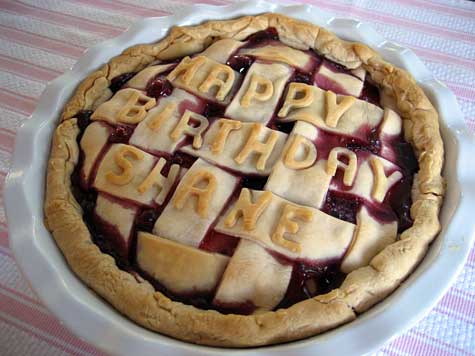
Birthday Pie Apparently my friend isn’t the only one who likes Birthday Pie. Original photo from: merrimentdesign

Suna’s birthday is this Saturday. So I’ve been thinking a lot about birthdays.

This is a list of Table Topics questions I used at today’s Toastmasters meeting. Rather than having volunteers choose a number, I just picked a topic for them, including (jokingly) asking the guy I know never watches movies, “What’s your favorite birthday movie?”

  • Tell us about your favorite birthday memory.
  • Tell us about your worst birthday experience.
  • James Doohan who played Scotty on original Star Trek series, would’ve been 91 today. Tell us about your favorite Scotty moment.1
  • Do you keep your birthday secret from your coworkers? Why or why not?
  • Describe the wonders of cake.2
  • How do you usually celebrate your birthday?
  • Adults typically fall and one of three categories:
    • They lie about their age.
    • They don’t worry about her age and may not even know what it is.
    • Or they are proud of their age.
    Into which camp do you fall, and why?

Notes

  1. Substitute any celebrity birthday.
  2. I half expected to get a dissertation about the band, Cake. Instead, I got a wonderful story about birthday pie.

Wednesday, January 12, 2011

A Cup of Statistics

Risk Analyst Hoodie As this hoodie (available on Cafe Press) suggests, we should always be aware of risk. Relative statistics do little to help us evaluate the risks we take.

Here is the text of the speech I delivered today at Toastmasters. It is a bit of a ramble because I procrastinated and didn’t have time to apply sound instructional design to it. I also tried a physical ending, which confused at least one member of my audience.

The speech ran a little long, so I’ve marked some of the text for removal if I ever deliver it again.

Mark Twain may have said it best. “There are three types of liars: liars, damned liars, and statisticians.” In his 1952 classic, Elementary Statistical Analysis, Harry Hartkemeier says Twain implies that statisticians “have reached the superlative.” There is no better liar than a statistician.

But as much as we distrust statisticians, we all love to bandy numbers to support our points. I’ve heard that as much as 67.8% of all statistics are made up on the spot.

We love numbers, but we believe them only when they support our views. Why is that?

Have you ever deliberately falsified the numbers to support your claims?

Do you know someone who has?

Yes, we’ve all read about sloppy scientists who have [falsified the data]. We may know someone who has. We may even have done so occasionally ourselves, as with my reference to the percentage of impromptu statistics. Actually, less than half of all statistics are made up.

So why don’t we trust statistics?

  • They don’t seem to yield any useful information.
  • They are often contradictory.
  • They’re almost always confusing.
And speaking of statistics made up on the spot… Photo source: Dirt & Seeds

Like many on the right, I blame the liberal media. And like many on the left, I blame Fox News.

The media has become fixated on numbers. Statistics make sloppy reporting sound more credible. And in the drive for audience, they focus on one type of statistics above all others—relative statistics.

Now you won’t be able to find a textbook on relative statistics. It isn’t a real branch of the actual science. That comprises:

  • Descriptive statistics, which summarizes data by describing what was observed in a sample
  • Inferential statistics, which uses patterns in the sample data to draw inferences about the data

Inferential statistics is most often used in scientific research looking for a correlation between two variables.

And that’s where we begin to get into trouble. The first problem is that people unfamiliar with the scientific method confuse correlation and cause even though the first thing you lean in Intro to Statistics is that correlation does not equate to cause. Correlation does not equate to cause.

Early in the century, two separately reported studies told us that people who drink more than four cups of coffee every day have:

  • A 40% increased risk of colon cancer
  • A 40% decreased risk of heart disease

Sounds like a wash, right?

But increased and decreased risk are relative statistics. Even saying that something increases your risk of dying by 100% doesn’t give you enough information to make an informed decision.

  • If choosing one behavior over another increases your risk from 1/1B to 2/1B, that is a 100% increase—but not much of a risk.
  • If it increases your risk from 1/1000 to 1/500, it’s still a 100% increase. And it poses a much more immediate risk.
  • But even in the second case choose one behavior or the other won’t ensure you to live or die.

Another way relative statistics causes problems is that the media may only report one side of the equation. NaturalNews.com reports on a study in Archives of Pediatrics & Adolescent Medicine saying that women who take antibiotics during pregnancy are significantly more likely to deliver babies with birth defects than those who don’t.

  • Mothers of children with a fatal skull and brain malformation were three times more likely to have taken a sulfa drug than women whose children did not have the defect.
  • Kids with cleft lips or palates were twice when mothers had taken nitrofurantoins, which were also linked to congenital heart defects, eye defects, and being born missing one or both eyes.
  • Penicillin was associated with a higher risk of a kind of limb malformation.

The report fails to mention what these women were being treated for. We have no information about whether the conditions the women had could have similarly damage or even killed the fetuses. We do know that if the disease had killed the mother, the baby would not have had a birth defect.

The media loves to report relative risk because phrases like “100% increased risk” or “three times more likely” or “half as likely” get your heart going. They scare you. They make you want to pay attention to what the reporter says.

And about coffee: it turns out coffee may reduce the risk of colon cancer by speeding the passage of carcinogens through your gut. Web MD says the decreased risk of heart disease ranges between 19%–91%—no descriptive statistics there.

But it does explain the mechanism of the reduction: antioxidants and anti—inflammatory compounds in the brew.

So the next time you hear about relative risk, know that the information is probably reliable but useless. Hearing the numbers should start your research, not make up your mind. It’s up to you to find out what the numbers really mean.

Oh, and now they say coffee also reduces your risk of Type 2 Diabetes. Who cares if the statistics are only relative? I’m going for another cup!

Not one of my best efforts. Maybe I’d give it a B.

Thursday, November 11, 2010

A Mama’s Boy Remembers

Mom and Me. Full picture on Facebook.Mom and me somewhere I don’t recognize

Here is another of my speeches for Toastmasters. It is Speech Six from the Competent Communicators manual, Vocal Variety. I delivered it today.


I’ll warn you up front, this is a bit of a ramble. Memories tend to be. They all blend together over time, especially the important ones, forming a gentle patina.

Even though she had to quit high school and go to work when her parents died within six months of each other, my mom was one of the smartest people I’ve ever known. She was also one of the funniest, but you’d never know that by the jokes she told. Let me give an example:

Two painters were going though the countryside painting churches. Even though it was the Depression and they didn’t have a lot other than each other’s company, the never went hungry. But being people, they wanted more.

One day one of them said to his partner, “You know. If we thinned the paint, we could paint twice as many churches for the same cost. We’d make a lot more money.”

“We sure would,” Partner said. “Let’s do it.”

So the next church they painted, they thinned the paint. They were just finishing up and thinking about how much money they’d make when a thunderstorm blew up. The thunder crashed, the wind blew the rain sideways, and the storm washed all of the thinned paint off the building.

Looking at the havoc the storm had wrought on their work, they were devastated. “What are we gonna do now?” they moaned.

A voice from the clouds advised, “Repaint and thin no more.”

Mom’s sense of humor was gentle and consistent.

  • I remember her trying to cheer up the ICU staff—telling jokes and pretending to dance while she was dying strapped to a ventilator.
  • I remember her worrying that I would have to drive home after dark the night before she had open heart surgery.
  • I remember her making my girlfriends in high school laugh by making fun of her own outlandish garage sale jewelry.

She had this one necklace that had these two huge gold-painted balls dangling from a string of plastic pearls. I heard her cry out from the kitchen one day. I rushed to see what was wrong. “Oh, it’s nothing,” she said. “I just closed the oven door on my balls.”

Now there’s a visual that will give a teenage boy nightmares.

How do I know she was smart? Other than my dad, I admired two men who respected her.

Mr. Morrison, ran a construction company and owned several banks.1 He helped convince Lloyd Bentsen, the senator for whom much of US-59 is named, to go into politics. When the salt dome in Louisiana caught fire in the mid 1970s, Mr. Morrison called Senator Benson. “Lloyd,” he said. “It’s just like our goddamn government. First, they buy up all the oil, driving up the price so nobody can afford to drive.2 Then they put in back in the ground where we’ll never get all back out. And now they’ve set the sonuvabitch on fire,” he exclaimed slamming the phone back on the hook. We used to take bets on how many times it would bounce before it fell off his desk. That time it bounced three times before crashing onto the worn linoleum floor.

Mr. Morrison didn’t mince words. He fired his building superintendent three times one day. Then called him up the next morning and cussed him out for not showing up for work.

Mom was his sales manager. She was the person he consulted when buying or selling houses for more than a decade.

That’s one way I know she was smart. The way I know was my grandfather.

Granddaddy was a typical early-20th century German farmer. He defined chauvinism. When he was ready to retire, he called the family together to get advice on what to do with the farm. My dad and uncle Carole started to say something, but Granddaddy cut them off with a flick of his hand. “I don’t care vat you say. I vant to know vat Kay sinks I should do.”

This August marked the 10th anniversary of her death.

I still miss you, Mom.

But rather than closing on a down note, here’s another one of her favorites:

A cop pulled a man over for not signaling a left turn.

“But I did signal,” the man protested.

“No, you didn’t.”

“Yes, I did,” the man insisted. “Just ask my wife. She was sitting right here beside me. She saw me signal.”

“Well, ma’am” the cop said. “Did he signal?”

“Well, officer. If I’ve learned anything in 40 years of being married to that man, it’s never to argue with him when he’s drunk.”

Notes

  1. I really don’t know the extent of Mr. Morrison’s wealth. He lived in a really nice house, but his faded Olds was at least a decade old. That’s 10 years in the salt and chemical fallout of Brazosport, Texas. I remember him griping about the amount of taxes he had to pay on the sale of a bank. Mom told him, “I just wish I made as much as you pay in taxes.” I think he kept her around for perspective, too.
  2. As I recall, gas prices were astronomical—around a dollar a gallon, but that was when you could find it.

Thursday, July 15, 2010

The Lion’s Share of Meaning

A Lion RoarsNever trust a hungry lion. Photo source: Richard Wiseman Blog

Today’s post is the text of a speech I delivered at Toastmasters today. I hope you enjoy it.

A word can mean so many things – anything, everything, or nothing. We argue over the meaning of words incessantly. Nobody wins.

Today, I’m going to talk about the intersection of semantics and lexicology – that lonely place where meaning lives.

Don’t be scared. That’s almost all the linguistic jargon I’m going to use.

Jargon is one of my favorite words. It comes from a French word that means “the twittering of birds.” In what John Ciardi, one of my favorite etymologists, would call “ghost etymology” (a word history somebody made up because it sounds good), I once read jargon comes from jargere, which the writer said means “to make a choking, strangling noise at the back of your throat.” I wish I could verify that particular meaning.

Every profession or clique has its own jargon — its own theives cant — designed as much to streamline communication within the group as to occult it from outsiders.

Instead of jargon, nomenclature, or whatever, I’m going to tell a story I like to call “The Lion’s Share of Meaning.”

But before I get to that, let me ask you a question.

Is it more important to be understood or to be right?

Robert Heinlein said, “If you’re arguing with your spouse, and it turns out you’re right, apologize immediately.” He also said, “You can be forgiven for being wrong a lot faster than for being right.”

Have you ever heard an argument so rabid as one between two people who agree with one another but use different words to state their points? Not unless it was one that arose from a broken understanding when people used the same words to mean different things.

These are often the arguments that lead to irreconcilable hurt feelings, to the dissolution of friendships, to violence.

Pride and Words are at the heart of these arguments. We seem to have an unquenchable need to be right. Sometimes it’s easier to say someone else is wrong than to prove we’re right.

And that calls into question the meaning of being right. What does it mean to be right?

The story that comprises the lion’s share of my speech comes from Aesop via John Ciardi.

What does “the lion’s share” mean?

Here’s how it started:

The lion organized a hunting party. After the party made the kill, the lion stepped up to the carcass and said, “As the King of Beasts and organizer of this hunt, I deserve half of the kill.”

The other animals grudgingly admitted that was the lion’s right. So does “the lion’s share” mean half?

No. As the other animals closed in, the lion raised his voice. “And my wife and children deserve half of what remains because they are my family.” Again, the rest of the hunters conceded the right of the lion’s family to another quarter of the carcass. So does “the lion’s share” mean three-quarters?

Not really. As the hungry hunters hunkered closer to the carcass, the lion said, “And I’ll fight anyone who wants any of the remainder.”

So “the lion’s share” doesn’t mean half or most or three-fourths. It means the lion wants it all. But if you use the phrase correctly, nobody will know what you mean. As John Ciardi advises, “Never be so right as to be misunderstood.”

It’s more important to be understood than to be right. It’s more important to understand what each other’s words really mean. Sometimes you may find, you agree.