Showing posts with label ghosts. Show all posts

Sunday, August 03, 2008

Book Review: From the Dust Returned

Book Cover. No larger image.
Bradbury, Ray, (2001). From the Dust Returned. New York: William Morrow.
Photo source: LibraryThing

Like many of Bradbury’s “novels,” From the Dust Returned (hereafter referred to simply as Dust) began its life as a collection of short storied, most of which date from the 1940s. Most of these short stories are quoted in their entirety, becoming a “chapter” in the “novel.” I quote the words novel and chapter when applied to Dust because it is simply another short story collection bound together by a tenuous story line inserted as an afterthought and declared a novel.

Bradbury has never made any pretense of being anything other than a writer of superb short stories. He readily admits that his first novel, the classic Martian Chronicles, was simply a collection of unrelated short stories that shared a common setting. He repackaged these stories to get a publisher who demanded a novel to accept them.

Dust follows this tradition. Much of the book consists of a series of esoteric short stories that are really more word paintings than stories written in the 1940s, I assume the publishers were buying only two words in the stories: Ray Bradbury. The rest of the book consists mainly of new word paintings that tie the older stories together and provide a semblance of plot. Bradbury’s style is such that I couldn’t sort the older stories from the newer ones without consulting the acknowledgments.

Many of the transitions are abrupt, flinging the reader haphazardly from one frame of the comic to the next. But Bradbury’s eloquence quickly sooths any jangled nerves.

Now, there were times I was tempted not to pick the book back up. (Indeed, I may have set it down the first time I tried to read it; I found a bookmark a little more than half-way through.) If you’re looking for one of Bradbury’s more accessible works—say Fahrenheit 451 or Something Wicked This Way Comes, look elsewhere.

You should read Dust for the beauty of Bradbury’s language. Bradbury is a word painter who creates dramatic scenes in the reader’s brain though his mastery of poetic language. In rereading this work, I didn’t care that there is no real plot to follow. Neither did I care that the characters are mostly flat—more line drawings than portraits. Bradbury’s language is its own reward. It doesn’t knock the reader out of the story because there is no story, only flowing, beautiful language. Just make sure you’re in the mood for that kind of book before you pick this one up.

Thursday, October 25, 2007

And When I Die

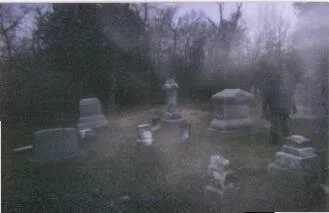
Is this a ghost? Matt says the figure appeared after the negatives were developed. Photo by:Matt from Springfield, Illinois
Now troubles are many,
they’re as deep as a well.
I can swear there ain’t no heaven
but I pray there ain’t no hell.
—Laura Nero

I came across an interesting article (Roach, 2006) this week. It lists several failed attempts to scientifically prove that something of ourselves survives death.

Most of these attempts were funny. One was tragic. That “researcher” set up a means to verify that any postmortem communication was from him. Then he locked up his apartment and turned on the gas, literally giving his life for science.

The question that the article fails to address is this: Why do we feel the need to “scientifically” prove an afterlife? We are a long, long way from having the instrumentation required to measure the presence of the soul, and it is impossible to measure its absence.

The afterlife falls into the realm of religion and belief. That is a completely different system of understanding the universe than science, and the two realms do not seem to overlap. True—brain researchers have now identified a structure in the brain that is responsible for religious experience. But they are unable to say whether that structure evolved (or was designed) to experience real spiritual phenomena or as a mechanism for social control that encourages us to work together for our common survival, occasionally at the cost of our own individual survival.

I do not believe that science and religion are incompatible, merely two different approaches that may yield inconsistent results. I know several Christian scientists (note the small s; I don’t personally know anyone who claims a capital S.) who have fairly strong religious beliefs. All of them manage to compartmentalize the two belief systems.

So I guess the point of this ramble is: Believe what you choose, but don’t think your religious beliefs are fact—we neither prove nor disprove them. And don’t try to force them down anyone else’s throat.

When it comes to the afterlife, my father’s saying applies. “We’ll see.” Or maybe we won’t. If not, it won’t matter to us then.


1 Roach, M. (2006, November 18). “The Big Questions: What happens after you die?” Retrieved October 25, 2007, from New Scientist: http://www.newscientist.com/channel/opinion/death/mg19225780.075-the-big-questions-what-happens-after-you-die.html