Showing posts with label Helping people. Show all posts

Saturday, July 30, 2016

Austin’s “Affordability Crisis”

High prices mean more people, especially young people, are renting again. Pricedoutforever.com argues that this is a good thing. I’m not certain if its good for them, but it is a good thing for investors. Photo by Pricedoutforever.com
This post originally appeared on the Hermit Haus Redevelopment website on 2016-07-23.
The median price of a single family home in the City of Austin rose 3% to $350,000 in June. When you take the surrounding cities into account, the median price was up 8% to $295,000. This sounds like great news to investors, but it actually makes our game riskier. Just as the higher prices are denying many first-time home buyers and lower income families the opportunity to buy a home in Greater Austin, they make it harder for investors to find the margins we need to sustainably run our businesses. Not impossible, just harder.
If you talk to a real estate agent, they’ll say, “Buy high, sell higher.“ But remember agents are motivated by commissions, and they get paid no matter which way the market trends. They get paid more if it goes up, but they still get paid if it goes down, assuming it doesn’t collapse and they can still sell something.
The more people get priced out of the market, the fewer people there are to buy any given home. That doesn’t seem to be a problem yet—along with the "affordability crisis" the ABOR article mentions, we have a supply crisis. Our inventory levels remain at historical lows, less than two months. I’ve even heard speculation we may see a one month inventory in the near future. That means, despite the price, someone is buying all the houses that are for sale, and it’s not just investors.
Remember, a stable market has around six months of inventory. So we are still in a really hot market.
While the trend in median home price continues upward, it is not a straight line. You can’t count on appreciation to save your donkey. Data source: Austin Board of Realtors®
But consider this: this business is cyclical, and it can turn on a dime. Add to that what our mentor Shenoah Grove says: "We’re currently eight years into a five year cycle," and you can begin to see why some investors are starting to talk about bubbles. And finally, I’ve seen a market correction in the first year of every new administration since I can remember, regardless of which party was involved. So you have to ask yourself if we are approaching the crest of the wave.
Over time, real estate has always appreciated. But that appreciation isn’t a straight line, unless your talking about the very long run. It’s downright bumpy. And as I’ve always said, to reap the long term benefits, you have to survive the short term. Or as I once heard Alan Greenspan quote John Maynard Keynes when asked why investors don’t plan for the long term, "In the long run, we’re all dead."
So how do we continue to help people and make money in times like these? We have to stick to basics.
  • Don’t buy assuming appreciation will fix our mistakes. I think it will...in the long run—if we survive the short run.
  • Know your end buyers well enough to improve the house to the right level, neither over improving nor under improving.
  • Remember your time lines and try to eliminate slack from your schedules. This one is really hard right now when contractors and subs still have more work than they can handle. Why do should they care about your schedule?
  • Manage your holding costs. Use private money rather than hard money. Use bank money rather than private money.
  • Partner up to spread the risk. You only shoulder half the risk with a seasoned partner, but you only get half the profit.
That said, don’t forget the motto I learned from my mentor Than Merrill: “People first, profits second.“ This business revolves around solving other people’s problems. Even in these high-priced times, even when the market turns down, if you can help people solve their problems, this business will continue to be rewarding and profitable.
For the full report on the June market from the Austin Board of Realtors, see Austin-Round Rock home sales on pace to surpass 2015 record levels amidst affordability crisis

Wednesday, April 06, 2016

Lakeland Closes

We closed on the purchase of this lovely house today.
This post originally appeared on the Hermit Haus Redevelopment website on 2016-03-30.
We closed on the purchase of our second Hermit House redevelopment property today. It is a lovely two-story house in Pt. Venture.
The Lakeland house currently has a view of the lake only from one window in the master bathroom. In fact, you have to stand in the tub to see the lake. We hope to rectify that situation by adding a second-story deck that will be accessible from new doors out of the upstairs living area and a stair case from the existing backyard deck.
Our exit strategy for the property is currently in flux. We have several options, but all will remain on hold for the short term because Carol and Russell will rent the house for the short term. They sold their primary residence but haven’t found another suitable property. Investors tend to move a lot.
This house is an excellent example of a win-win. The previous owners needed to sell the house to move on with their lives. A previous attempt to sell at full market had failed. We were able to put cash in their pockets and enable them to pursue their life goals. And simply buying this house improves our balance sheet.
This is my favorite kind of deal: everybody wins.

Wednesday, March 30, 2016

People Matter

Heart makes [the redevelopment] business rewarding. Money only makes it possible.
This post originally appeared on the Hermit Haus Redevelopment website on 2016-03-22.
We like to say we are “redevelopers” instead of “flippers” for a couple of reasons:
  1. We are not dolphins.
    By the most common measures of animal intelligence (brain weight and the ratio of brain cells to body cells), dolphins are probably more intelligent than humans are. That would make Flipper smarter than me.
  2. Flippers have something of a bad reputation.
    Deserved or not, many people think of flippers as preying on the weak or just taking advantage of other people’s misfortune. After all, we buy below market and sell at the top of the market.
While some do take advantage, most of us want to do good in the world. We will even walk away from a deal if we don’t feel we are doing right by the seller. To that end, I want to share a story from a fellow redeveloper, Cheryl Thompson. I met Cheryl though FortuneBuilders, an investor group to which we both belong. She posted this story on the group’s closed Facebook page and gave me permission to reproduce it here.

Last week I got an opportunity to spend time with a woman who was selling her parents’ home. Three bedroom/1 bath. Amazing hardwood floors. She walked me through the impeccable and memory filled home that her father had built in the 1950s. The property in top condition would be worth $90,000. My MAO (maximum allowable offer) would have been $30,000 – $36,000.
She told me how her father had died four years ago, and she bought her mother a condo that would be easier for her to get around in after she had a stroke two years earlier. Now this kind and love-filled daughter had to sell the house. For most, this is the OPTIMUM opportunity. She explained how she was going to use the funds to keep her mom comfortable and safe in her condo with nursing staff and how she was managing all this single-handedly.
As I walked through the house, my rehab hat was making a detailed list of items that would have to be done to the house to get top dollar. My heart hat was listening to the woman’s goals and knowing deep down that I had to use my knowledge to help her, not to fatten my own bank account.
I stopped in the middle of the basement and said to her, “I can’t buy your house. You have too much capital here to be able to take care of your mother with. I’m going to show you how to get top dollar for this house and put the money in your bank account for your mom.”
The tears in her eyes said it all.
We started the walk through again and I pointed out exactly what she needed to do to be able to list the property with a realtor. I told her what to pay attention to and what to let go. I gave her my favorite realtor team’s name and number.
She mentioned that even though her parents had had insurance with State Farm for over 50 years that State Farm had dropped her because the house was now vacant. I asked her who was insuring it…she said, “No one.” I panicked. An uninsured vacant house. At that moment I begged her to call my company, who insures vacant houses before the end of the day. She had 1 hour and 15 minutes to get it done…and $90,000 to lose if something happened to the house while she was getting it ready to sell.
When I was getting ready to leave, we hugged and agreed to stay in touch. I felt like I had run a victory lap knowing that this woman was going to be able to take better care of her mother for at least 1-2 years because of our 30-minute meeting. She would insure it, get it ready for sale, hire a realtor, and feel a little bit less overwhelmed because our paths had crossed.
This is one of the most beautiful things about FortuneBuilders. We have knowledge (lots of it) that we can put to work for great good.
I love deals. All kinds. But the best deal you can ever make is one that will make another person’s life a whole lot better.
Since we started Hermit Haus Redevelopment, I have not had the opportunity to help someone like this. The people we have talked to have many reasons for just wanting out of the house. Either they don’t have the money to do the rehab themselves, or they don’t have the time, energy, and patience an extended rehab requires. Giving these people what they want is not taking advantage of them. Sometimes they see the what’s in their best interest in terms other than financial gain—like my father did when he sold the house he and my mother had lived in for $20,000 less than its “as-is” value. He felt it was worth $20,000 to move out of a house with too many memories and move where he could begin to rebuild his life after Mom died.
If you know of someone who wants out from under a house that has become a burden for them, we are happy to help by buying that house. If you know someone who wants to know how to get top dollar for their house, we can help with that, too.

Wednesday, March 16, 2016

Sad Houses and a Service Mindset

I still try to live by the words of cultural icon and personal hero John Lennon, who said, “There are no problems, only solutions.” Photo by: Unknown
This post originally appeared on the Hermit Haus Redevelopment website on 2016-03-09.
Hermit House Redevelopment approaches every unique situation with a service mindset. We ask the question, “How can we help,” and we put our mission statement out there on everything we do:

We buy sad houses and make them happy again.

What does that mean? Or as one of our private money lenders put it, “Lee, what the hell is a sad house?”
A sad house is one that is not living up to its true potential. As with people, lots of things can make a house sad. Between the four of us on the Hermit Haus leadership team, we’ve probably seen them all at least once.
It all comes down to how you look at things. There are no opportunities without problems. You can focus on the problem or the solution. Granted, sometimes the solutions require more resources than you have. That’s where we come in. At Hermit Haus Redevelopment, we specialize in finding the resources that enable us to provide solutions.
Without going into too many details, here are a few examples:
Neglect
A couple of our recent projects involved deferred maintenance—repairs that were put off so long that their volume became overwhelming. One house stood vacant for more than a decade. Another was ignored by its owner until there was more wrong with it than he cared to address, even though he had the money to renovate it before he sold it.
In both of these cases, we gave the owners what they wanted: a quick sale without having to go through the trouble of dealing with contractors and hoping they would get the money the spent on renovation back out of the house.
Changing needs
We are currently acquiring a beautiful house, one that I would be happy to move into without doing any renovation whatsoever. The owners tried to sell it once before, but couldn’t get any traction in a down market. Now their needs have changed. and they don’t have time to wait for it to sell, and they were leery of trying given their previous experience.
What the owners of this house wanted most was to be out from under it. Even though we couldn’t give them what the house was worth (at least in their eyes), we could free them from a crushing two-hour commute to work after a job chance and the worry of another failed attempt to sell the house.
From personal experience, I know that if someone I’ve talked to loses their house to foreclosure, I have failed them.
Financial problems and foreclosure
As Carol and I have both mentioned, foreclosure is only the start of a nightmare that can last more than seven years. The consequences of foreclosure can sometimes return decades after the event.
Although we’ve purchased bank-owned houses, we haven’t been as successful in helping people avoid foreclosure as we want. After hearing the saddest sentence in the English language too many times, I’ve made it my mission to help as many people as will let me help them. If someone I’ve talked to loses their house to foreclosure, I have failed them. I obviously haven’t explained how I can help well enough.

Probate
We bought a house Sue Ann and I plan to homestead after it had been tied up in an estate for more than 20 years, vacant for much, if not all, of that time. During all those years, the estate had paid almost $10K each year in real estate taxes and more than $200 each month in HOA fees. I have no idea how much the insurance on the house ran. Luckily, the house was owned free and clear, so the estate didn’t have to make mortgage payments on an empty house. Even so, the estate spent almost $250K maintaining a house nobody wanted to live in. To be fair, there was an easement encroachment that scared off many potential buyers and their banks.
We freed the estate from future expenses on this house and paid cash for the house. In fact, we got the house even though our offer wasn’t the highest because the estate’s attorney realized we would be less likely to back out of the deal than buyers without our experience. Since then, we spent more than a year working with the City of Austin to resolve the easement issue and are in the process of finalizing the renovation so we can move into the house. I know the people moving into this house will be proud of it because they are us and we are proud of all the work.
Sometimes you have to tear something down to make it right again.
Poor workmanship
Another of our current projects involves an almost complete teardown and rebuild. The original owners did things on the cheap without regard to quality. We had to completely jackhammer the foundation and start from scratch. In the process of demolition, we found only three pieces of rebar in the original foundation. We also found electrical runs that were spliced together with electrician’s tape in the walls—a fire waiting to happen.
We bought this house from an estate, thinking that we were helping the heirs divest themselves of a property nobody wanted to manage. Instead, our primary service turns out to be making the house safe for anyone who lives there in the future.
Some people have said it sounds like we’re preying on other people whose problems have gotten the better of them. We’re not, but there are those in this industry who do. We don’t want to be vultures picking at the corpse of failure. We really do approach every deal with a service mindset. There is no Kobayashi Maru. We will buy your house or help you find some other solution. We want you to be as thrilled with the solution you choose as we are.

Monday, February 22, 2016

Balanced Investing in Real Estate

Me, me, me, and some famous people I address a group of investors with Ryan Connell of Grand Coast Capital and Paul Esajian of FortuneBuilders.
This post originally appeared on the Hermit Haus Redevelopment website on 2016-02-20.

We are attending a real estate investing convention hosted by FortuneBuilders this week. Anyone who has ever an event like this knows that you are running from the time you wake up in the morning until the time you fall into your hotel bed at night. There is so much to learn and so many people to meet!

And the people are the best part of it. I met another investor who lives in Milam County, where our ranch is and where we hope to retire someday. Isn’t it ironic that I had to travel to a convention to meet a neighbor with whom I have so much in common?

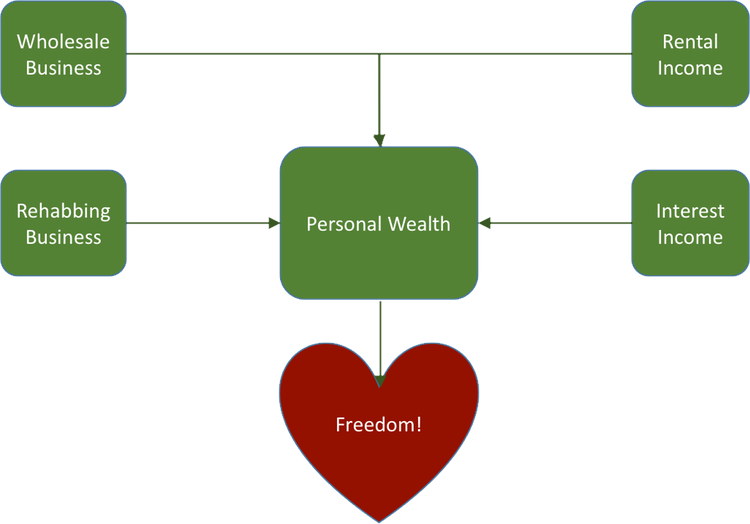
But the highlight for me was being asked to address a group of fellow investors about investment strategies and how you can be fully invested in various aspects of the real estate economy and still have a comfortable degree of diversification. I hadn’t spoken in public since I left the corporate world a few years ago, and this crowd was the largest I have stood in front of since I left rock and roll behind in the 1980s. Being asked to explain your investment strategies to a crowd of more than 300 fellow investors is very exhilarating and very humbling.

A very complex graphic A balanced approach to investing can help you achieve the goal of personal freedom—whatever that means to you.

My points echoed the advice of all my mentors:

  • Wholesaling and redeveloping properties should only be one part of your overall strategy. These activities have the highest reward, but that means they also have the highest risk.
  • A rental portfolio can help you build real wealth over the long haul, but it is also not without risk.
  • Putting your money to work by buying into or investing with a hard money lender can generate moderate income while spreading the risk over a much broader pool than lending on a case-by-case basis, but the returns can be lower.

For the last point, I have a considerable chunk of my investment portfolio in Grand Coast Capital, but I still engage in private money lending. While I intend to increase my Grand Coast investment over time for a more certain return I still enjoy helping my fellow local investors achieve their goals when I have free capital to invest with them.

JP Getty once said that the best way to get rich is to help others get rich. Not only is helping others efficacious, it is the most rewarding path. Helping others is not just part of our mission statement at Hermit Haus Redevelopment, it is our core value.

So I would be remiss in my helpfulness if I failed to include this caveat: Nothing you do in the investment game is without risk. As my dad used to say, “If it was easy, everyone would do it.” What he didn’t say was that if it was easy (or risk-free), there wouldn’t be any profit in it.


Wednesday, November 11, 2015

Why I Want To Stop All Foreclosures

Stop Sign with Foreclosure I want to stop all foreclosures.
This post originally appeared on the Hermit Haus Redevelopment website on 2015-11-10.

Growing up in a real estate household, I was an early bloomer. I bought my first house at 19. It was a 2-1, built in the 1940s. Being so young, I didn’t have enough credit to get traditional financing, so I bought it with a Contract for Deed—a vehicle that is now illegal in Texas because of abuses by unscrupulous lenders.

Everything was going great until one day I did what many people do. I lost my job and couldn’t make the payments on my little house. I tried to make partial payments, and the contract holder accepted the first two. When I found work again, he refused to accept anymore payments and foreclosed on the house.

Luckily, I had an “unfair” advantage. My mom was a Realtor®, and she knew a good real estate lawyer. The contract holder was surprised to see me in court and even more surprised to see I had a lawyer. Most of the people in my situation apparently just walked away from the house.

The judge (justice of the peace, actually) ruled in my favor because I had the money to catch up the back payments plus interest. My lawyer didn’t even have to speak. The contract holder protested, “I don’t want the money. I want the house back! It’s worth more now than when I sold it to him.” The JP picked up his gavel to say something else, but the contract holder’s wife pushed him away from the bench, telling her husband, “Shut up, Harry. We lost.”

Even though almost 40 years have past and Contract for Deeds are now illegal in Texas—as are lease purchase options of any substantial duration… Even though we had the Crash of 2008 and the resultant Dodd-Frank legislation is in place…predatory lending still goes on.

While I’ve been working to save the credit of the homeowners I’ve seen banks do everything in their power—from repeatedly “losing” paperwork to intentionally dragging out the process for months—to force houses into foreclosure. It still makes me as angry as it did the time I almost lost my own house. I understand the home owners’ frustration and sense of powerlessness. I really want to help in the only way I can, by trying to salvage what’s left of their credit. I have more than one tool at my disposal to help, and I feel really frustrated every time I see a big bank take a fellow human being’s house away.

That’s why I work so hard to stop every foreclosure I can.

Don’t go through a foreclosure yourself without at least looking at the options. And don’t let anyone you know go through an unnecessary foreclosure. Learn how you can stop foreclosure by downloading our free booklet.

Thursday, November 05, 2015

The Saddest Sentence in the English Language

This is how foreclosure feels. First there’s the dread of the inexorably rising debt as the event draws near. Then your house gets swept away in an impersonal flood of legal procedure. Photo by Carsten Knoche
This post originally appeared on the Hermit Haus blog on 2015-11-04.

Foreclosure is a financial tsunami.  It sweeps away years of good credit practices into a black hole of future agony.  For years, up to a decade, after a foreclosure,  foreclosed persons can’t escape the enormous gravitic pull of the black hole as it stretches pulls, stretches, and tears at them, trying to suck them down into a pit of financial oblivion.

Losing a house to foreclosure is just the start of a decade-long nightmare that makes Freddy Kruger look cuddly.

  • It will be years before they can buy another car or truck, except at a “note lot” that specializes in taking advantage of people with poor credit—often by requiring them to come up with an astronomical down payment that covers the seller’s total investment in the vehicle.
  • They won’t be able to buy another house, and since most apartment communities use credit score to qualify prospective tenants, they may not even be able to get a nice apartment.
  • The foreclosing bank can file a 1099 showing the unpaid balance of the mortgage plus fees and additional interest as income, which causes the IRS to come after them for unpaid taxes on that income.
  • Even in states that don’t allow creditors to garnish wages, the IRS can.

It’s a process that can be avoided. One of our primary goals at Hermit Haus Redevelopment is to help distressed homeowners avoid foreclosure. We have several tools to chip shore up against foreclosure in our tool box (buying the house for cash money is only one of them). And, of course, we make money doing it.  If we didn’t make money, we couldn’t continue to help more people.  And our whole reason for existing is to help as many people as we can.

But people have to let us help.  And that brings us to the saddest sentence in the English language.

Are you ready for it? Here it is:

“No, I trust my bank.”

Carol and I had been working to get a family to allow us to help them avoid a foreclosure.  Last Thursday, the homeowner said, “No, I trust my bank.  They said they would help us with the loan.”  Yesterday, the house sold at foreclosure auction.  The bank’s opening bid was higher than the after repair value of the house.  They really wanted it.

Please don’t trust the bank.  And please don’t let anyone you know suffer through the financial nightmare that is foreclosure.  Call us.  Call our competition!  Please, call someone who can help.