Showing posts with label financial intelligence. Show all posts

Tuesday, May 19, 2020

“It was paper when we started...”

Photo by The New York Times I remember thinking at the time, “That’s easy for you to say.”
The best things in life are free
But you can keep them for the birds and bees
Now give me money
(That's what I want)

—Berry Gordy, Janie Bradford

It’s not often you’ll hear me say I learned a valuable lesson from Sam Walton, but today is one of those days.
Thanks to declining production and falling oil prices, I had to take a huge write down in the valuation of one of my properties yesterday. It was frightening and disheartening.
To be clear, this isn’t real money. It didn’t come out of my pocket, but it does affect my net worth. And banks tend to look down on reductions in net worth.
So, I’m grateful for the lesson I learned from Walton way back in 1987. After the stock market crashed on Black Friday, he lost about a half-billion dollars in Wal-mart’s market capitalization the following Monday. Walton shrugged off the loss. He said, “It was paper when we started, and it’s paper afterward.”
I remember thinking at the time, “That’s easy for you to say.” But the truth is, paper losses hurt about as much as paper gains help. That is to say, not much. I still own the land, and my taxes will go down because of the write down.

Tuesday, April 12, 2016

Entrepreneurial Blues

A good entrepreneur finds balance. Image by: Bitmoji
This post originally appeared on the Hermit Haus Redevelopment website on 2016-04-05.
Warning: This post can be construed as whining. If I hadn’t promised to be as honest as possible about our journey, I wouldn’t post it. It sounds like whining to me, and I don’t like whining. Feel free to skip it. But if you want to know what it’s really like to run a small real estate redevelopment company, I guess I’m writing this for you.
When you’re getting started—and possibly even after you’ve been doing redevelopment work for awhile—you don’t have a huge staff to rely on. Some of the many tasks required to keep a company like this one working include but are not limited to the following (presented in no particular order):
  • Finding money
  • Budgeting
  • Plowing through the MLS
  • Prospecting for buyers, sellers, contractors, handymen, etc.
  • Reviewing contracts
  • Signing contracts to buy, sell, and finance projects
  • Keeping the books
  • Finding money
  • Monthly, quarterly, and annual financial reporting
  • Paying contractors, assistants, lenders, suppliers, etc.
  • Communications (blogging, Facebook posts, one-off letters, advertising, etc.)
  • Marketing, marketing, and marketing
  • Crunching numbers
  • Estimating repairs
  • Finding just the right wine
  • Finding money
  • Managing contractors and vendors
  • Setting policy and defining procedures
  • Negotiating with buyers, sellers, contractors, suppliers, etc.
  • Record keeping (physical and electronic documents like permits, licenses, contracts, etc.)
  • Envisioning, inspiring, and directing operations
  • Finding just the right whine
I believe in job creation, but I also believe in profits. So there are only four of us working on this enterprise, and we each have unique roles and skills. To oversimplify: Russell works on finding deals and keeping the back-end systems running. Carol is our real estate guru; she keeps all of our preliminary numbers realistic, is our numero uno marketeer, and manages projects. Sue Ann is our social media expert, editor in chief, and networker. That leaves most of the boring business stuff to me. I love what I do, but...whine!
We do have assistants—virtual and otherwise—who handle most of our secretarial work: printing, copying, and mailing marketing materials. But the other listed tasks (and many, many more) fall to one of the four principle investors.
What set off this whine-arama is that I spent almost my whole day for the last two days chasing down random bits of paperwork for lenders and title companies involved in two of our current projects. In a perfect life, this would have been work I delegated to a file clerk. Unfortunately, I am the file clerk (technician level, in Kiyosaki’s quadrants).
Now you learn in investor school to prepare for this by keeping the most commonly needed documents in a folder on your desktop. This I do. However, each transaction we do adds to that list of documents. My “Commonly Needed” folder now runs just over 8MB, compressed. I’m waiting for some bank or title company technician to balk at looking though it and ask, “Why don’t you just send me the documents I need?” But so far, they always find just one more document to request.
My advice: Keep smiling and telling yourself it’s all a brilliant learning exercise that you’ll get through and eventually have it all down and a staff to delegate it to. That or learn to “play the guitar on MTV.”

Saturday, February 27, 2016

Starting the Journey to Freedom

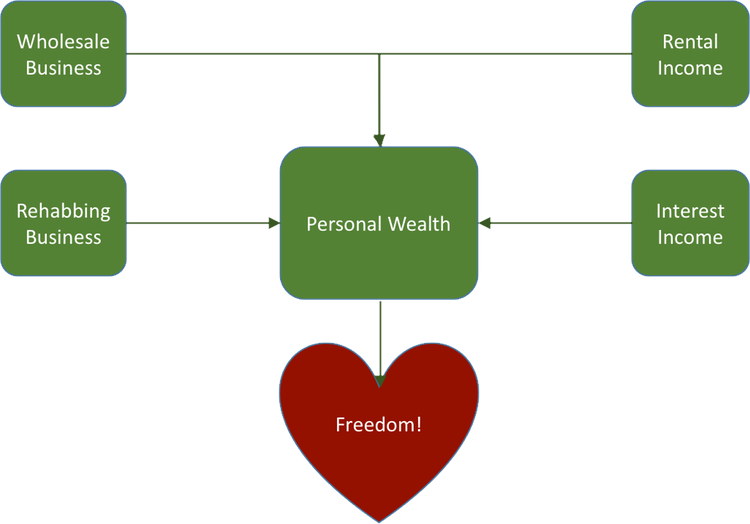
A very complex graphic A balanced approach to investing can help you achieve the goal of personal freedom—whatever that means to you.
This post originally appeared on the Hermit Haus Redevelopment website on 2016-02-25.

I’ve gotten several questions about the cash flow diagram in my last post, so I’m going to explain it in detail today.

First, if you haven’t already read Robert Kiyosaki’s short book Rich Dad, Poor Dad, I highly recommend it. I even bought copies for many of my friends and team members. It’s a short read, but it packs a lot of financial intelligence in amongst its folksy yarn. It’s not biography (or necessarily factual), but the fictive stories illustrate his points.

Kiyosaki categorizes income into two income families, each of which comprise two types of people:

Robert Kyosaki in front of his cash flow quadrants. Kiyosaki’s Quadrants
Active Income
  • Employees (E) have a job and work for someone else.
  • Self-employed persons (S) have a job but work for them selves.
Passive Income
  • Business owners (B) have a system that employs other people’s time, energy, and intelligence to generate income without requiring the business owner’s direct input.
  • Investors (I) put their money to work to make more money.

If you look closely at these two graphics, you’ll see how they align. Real estate wholesaling and redevelopment are essentially forms of employment or self-employment. If you don’t work at them, the income goes away. Rental and interest income are more passive, but managing rental properties can become a jobby-job. Ask me how I know.

That said, you could turn your active businesses more passive by employing enough people to minimize your active effort in them. That’s the goal, isn’t it?—to have the business create the income you use to buy your way out of it.

These are lessons I’m still working on. It’s very easy for me to get down into the weeds of my investments until managing them takes so much time I’m not creating new opportunities. Moving from the left side of the graphics to the right requires a real shift in mindset. It requires stepping away from the illusion of security into the security that comes from understanding how money works and how to make it work for you. That’s not an easy transition, but at least I can see where I’m going.

The goal of any income stream should be wealth creation. Wealth eventually becomes self-sustaining, unless you gamble it away or try to live above the means it provides. When wealth becomes self-sustaining you have achieved a goal most of us only dream of: freedom.