Showing posts with label Blue Ridge. Show all posts

Sunday, April 24, 2016

And It’s Gone Again

Selling a house can feel like shooting a rapids. It takes patience, stamina, and skill to get to the smooth waters at the end.
This post originally appeared on the Hermit Haus Redevelopment website on 2016-04-17.
The Blue Ridge house falling out of escrow is one of the forms of turbulence Carol writes about in her free handout “88 Forms of Turbulence.” Turbulence is anything that can make a deal go sour. It’s one of the things we protect sellers against when we buy a house. When we put a house under purchase contract, it stays sold. Unfortunately, we can’t protect ourselves against turbulence on the part of our buyers.
Within a couple of days after officially putting the Blue Ridge house back on the market, we again had multiple offers, and once again we accepted a full-price offer. Hopefully, it will stay sold this time. But when I was a kid, my mom used to tell me you had to sell a house three times to get it to close. So, who knows?

Tuesday, April 12, 2016

Entrepreneurial Blues

A good entrepreneur finds balance. Image by: Bitmoji
This post originally appeared on the Hermit Haus Redevelopment website on 2016-04-05.
Warning: This post can be construed as whining. If I hadn’t promised to be as honest as possible about our journey, I wouldn’t post it. It sounds like whining to me, and I don’t like whining. Feel free to skip it. But if you want to know what it’s really like to run a small real estate redevelopment company, I guess I’m writing this for you.
When you’re getting started—and possibly even after you’ve been doing redevelopment work for awhile—you don’t have a huge staff to rely on. Some of the many tasks required to keep a company like this one working include but are not limited to the following (presented in no particular order):
  • Finding money
  • Budgeting
  • Plowing through the MLS
  • Prospecting for buyers, sellers, contractors, handymen, etc.
  • Reviewing contracts
  • Signing contracts to buy, sell, and finance projects
  • Keeping the books
  • Finding money
  • Monthly, quarterly, and annual financial reporting
  • Paying contractors, assistants, lenders, suppliers, etc.
  • Communications (blogging, Facebook posts, one-off letters, advertising, etc.)
  • Marketing, marketing, and marketing
  • Crunching numbers
  • Estimating repairs
  • Finding just the right wine
  • Finding money
  • Managing contractors and vendors
  • Setting policy and defining procedures
  • Negotiating with buyers, sellers, contractors, suppliers, etc.
  • Record keeping (physical and electronic documents like permits, licenses, contracts, etc.)
  • Envisioning, inspiring, and directing operations
  • Finding just the right whine
I believe in job creation, but I also believe in profits. So there are only four of us working on this enterprise, and we each have unique roles and skills. To oversimplify: Russell works on finding deals and keeping the back-end systems running. Carol is our real estate guru; she keeps all of our preliminary numbers realistic, is our numero uno marketeer, and manages projects. Sue Ann is our social media expert, editor in chief, and networker. That leaves most of the boring business stuff to me. I love what I do, but...whine!
We do have assistants—virtual and otherwise—who handle most of our secretarial work: printing, copying, and mailing marketing materials. But the other listed tasks (and many, many more) fall to one of the four principle investors.
What set off this whine-arama is that I spent almost my whole day for the last two days chasing down random bits of paperwork for lenders and title companies involved in two of our current projects. In a perfect life, this would have been work I delegated to a file clerk. Unfortunately, I am the file clerk (technician level, in Kiyosaki’s quadrants).
Now you learn in investor school to prepare for this by keeping the most commonly needed documents in a folder on your desktop. This I do. However, each transaction we do adds to that list of documents. My “Commonly Needed” folder now runs just over 8MB, compressed. I’m waiting for some bank or title company technician to balk at looking though it and ask, “Why don’t you just send me the documents I need?” But so far, they always find just one more document to request.
My advice: Keep smiling and telling yourself it’s all a brilliant learning exercise that you’ll get through and eventually have it all down and a staff to delegate it to. That or learn to “play the guitar on MTV.”

Friday, April 08, 2016

The Win-Win Works

Proof of a Win-Win!!
This post originally appeared on the Hermit Haus Redevelopment website on 2016-04-01.
Independent proof of a win-win came through my Facebook feed today. The screen shot to the right is from the Realtor® who represents the buyers of the Blue Ridge property.
Love having my buyers come out on top in this crazy sellers market.
Those with a scarcity mindset might interpret McKinsey’s statement to mean that we sold too low. We didn’t. Even after negotiating with the buyer to establish a fair price, the house sold at the high end of the comparables. This is one of the best examples of a win-win scenario I’ve encountered to date.
We made money—just not as much as we might have had we not learned some valuable lessons about working with contractors. We can keep the lights on, pay the contractors, repay the loan to purchase the property, and put a little in our pockets.
I’m also very glad the buyers got a good deal. “People first.” I hope they will be really happy in the house.

Friday, February 05, 2016

Communication Is Key

Front of the house The siding is up on the kitchen bump out.
This post originally appeared on the Hermit Haus Redevelopment website on 2016-02-03.

The Blue Ridge project is still running behind schedule, and there were a couple of developments that will put it farther over its budget this week.

First the good news: the cabinets and countertops are in in the kitchen and both bathrooms. The granite countertops really pop against the white cabinets, which are not quite Shaker style. We even had the folding table in the laundry room topped with the granite.

And the siding is up on the kitchen bump out—the one where we had to remove the brick facade last week. Part of it got knocked down, and it was safer to remove the rest of the brick than to repair the remainder. The horizontal HardiePlanks echo the siding on the other three sides of the house. It looks good, even in the weird default primer color. It will look even better painted to match the house.

That brings us to the bad news and the title of this post. Last week, we messaged the contractor, Chris, a picture of the color fan showing the color we wanted matched against a wall. The contractor asked if we were sure, and we responded that we were without really understanding what he was asking. The problem is that each blade of the color fan has a range of shades of the color ranging from very pale to dark. We had used the lightest at a different house, and that one had a note written on it. Chris thought we wanted the color with the note, and we thought he would understand we wanted the one that matched the background against which we took the picture of the color fan blade. Neither of us actually mentioned the name or color code.

So when I showed up to inspect the property today, I asked in all innocence if they had just sprayed the house with primer. “No. That’s the actual color you guys chose.” Argh! The whole exterior of the house is the wrong color. So we get to buy more paint and pay to repaint the house: More money over budget and more time lost!

The bottom line is this: when you are talking with your contractors (or human beings in general), be as specific as you can. If you’re talking about paint, talk color codes and names. It’s an easy mistake to make and a difficult lesson to learn—again. Get Sue Ann to tell you about the time I had her house painted orange.


Monday, January 25, 2016

Paying Contractors

Paint supplies and a painted wall We have paint and texture on all drywall at Blue Ridge, but we seem to have lost a week in the process somewhere.
This post originally appeared on the Hermit Haus Redevelopment website on 2016-01-23.

The Blue Ridge project is taking longer than expected. Don’t they all? But the texture is on the walls and painting has commenced.

As best I can tell, we are about a week behind schedule without having encountered any serious delays, just a series of small ones. But, as with pennies, small delays add up.

This situation is an example of why you should pay your contractors on completion of tasks, not on a time-based schedule—no matter how good they are or how much you trust them. Unfortunately, we agreed to weekly payments on this project, mainly because we had too much going on, had our primary contractor back out of bidding because of too much work already booked, and urgent relief at having found a recommended GC who was willing to start two weeks earlier than anyone else. Not to mention the distractions of the Christmas season.

All of that now leaves us in a situation where we have to renegotiate the payment schedule at the end of the project.

When you pay on task completion, you risk having your project become a lower priority than “more lucrative” projects. On the other hand, paying on completion guarantees you won’t be paying for undone work, but it doesnt guarantee timely completion. Either way, delays increase your holding costs during a project.

Here are some lessons we’ve learned over time:

  • Have your contract written so you pay on completion of a task rather than on a schedule.
  • If the contractor is furnishing the materials, keep the upfront payments minimal, but reasonable.
  • Keep tabs on the work as it progresses, and don’t be shy about asking questions.
  • Always plan on paying at least 10% more than the bid. There will always be things you didn’t know about when the project went out for bid.
  • Plan for at least six weeks of holding costs beyond the scope of the project. There are almost always delays in the renovation and sale processes.
  • If you plan for a longer, more expensive project, you’re in good shape if it comes in on time and on schedule. The inverse is not true.


Friday, January 22, 2016

Construction Update: The Value of a Dumpster

Villa Park is a mess. The nanny suite has been skinned with hardiplank, but its emerging beauty is hidden by debris. Blue Ridge is much neater thanks to a dumpster. Thanks to the dumpster, Blue Ridge looks inviting, even in the middle of the renovation.
This post originally appeared on the Hermit Haus Redevelopment website on 2016-01-18.

This post started out to be a quick update on the two renovation projects we currently have running, but you know me: I can’t resist wagging my tongue when something finally sinks in. So, I’m going to preach (probably to the choir) about dumpsters first, and give a short update at the end.

Many rehabbers use dumpsters at their projects—certainly all of the ones you see on television. But others let the refuse pile up or pile it onto trailers to take to the dump when they are ready. The GC I have used for the last eight years falls into the later camp. “Why pay the money for a dumpster when I can haul stuff away much cheaper?” he asked the first time I suggested getting one. Not being intimate with that part of the business, his logic swayed me. He is handling the Villa Park project.

We decided to use a dumpster at the Blue Ridge project as we brought on a new GC who actually preferred renting a dumpster. The photos at the right show the difference between the two projects, both run by professional contractors who are very good at what they do.

I won’t compare overall costs, because the two projects are radically different and have produce dramatically differing qualities of debris. But priced by the yard, the dumpster method seems to win out, even in cost. Thirty yards of debris cost roughly $500 to dispose of at Blue Ridge. The same amount of debris cost about $450 to dispose of at Villa Park. So I saved $50 by having my GC haul off the waste. But take another look at the two pictures.

Now here are some hidden costs of having your GC dispose of the construction debris:

Lost work
Your crews aren’t making progress on your project when they are at the dump.
Neighborhood respect
While I haven’t received a single complaint about the debris at Villa Park, I haven’t had a single neighbor inquire about what we do and if we can help them. We have had a stream of neighbors at Blue Ridge wanting to see the project, and several talked about friends whom we might be able to help.
Workplace safety and productivity.
None of the crew on any of my projects has ever reported an injury. That said, I can’t help but believe piles of trash around a project have to decrease productivity as workers carefully negotiate the paths they have left.
Pride
While I am proud of the work we’re doing at both projects, and I know I will be extremely proud of the final products, I am ashamed of going to the Villa Park project now that I have seen a well maintained workplace at Blue Ridge. I believe the workplace conditions will also affect the pride of craftsmanship in the workers, too.

I am now an advocate. We are ordering dumpsters for the Villa Park project, and I have made a convincing economic argument to that contractor in favor of them.

Villa Park Update

We have now passed all inspections and are moving forward with finishing out the walls. The skylight has been removed and roofed over. It wasn’t leaking, but they eventually do.

Blue Ridge Update

All walls inside the house have been refloated after removing the popcorn. We lost a day because someone turned off the heat, and the drywall compound didn’t dry overnight. We should be ready to paint early next week, and the flooring will go in shortly thereafter.

Tuesday, January 05, 2016

Blue Ridge Demo Day

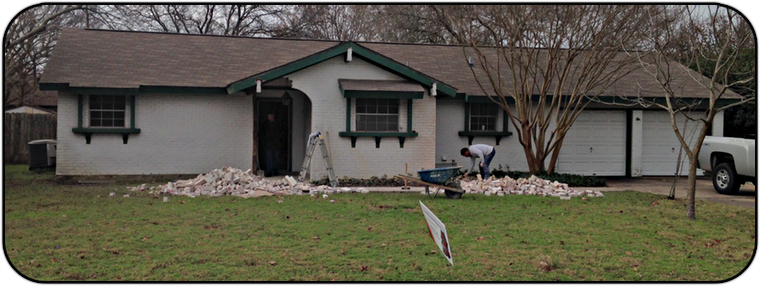
Blue Ridge house with demo debris in the front yard. Blue Ridge during demolition. Compare this to the photo of the Villa Park nanny suite below.
This post originally appeared on the Hermit Haus Redevelopment website on 2016-01-03.

It’s unusual that you can say that a house looks better right after you start demolition. The demolition process usually piles trash throughout the house and around it, making it look trashy or even scary. But as you can tell from the picture, the Blue Ridge house is an exception to that rule.

The first thing we did was to take out all of the excess shrubbery behind which the house originally hid. That opened up the front of the house and made it much more inviting. Unfortunately, it also emphasized the damage that is been done to the front arch.

Carol, Sue Ann, and I had previously agreed that we would take down the arches on either side of the kitchen to get the house and more modern look. I think that plan is working, even with the pile of rubble piled to either side of the kitchen.

The interior of the house is pretty much as described in the opening paragraph—trashy. The kitchen and both bathrooms have been gutted to enable a clean, 21st century renovation. The ancient carpets have been removed, and the faux beams have been taken down from the ceilings. All of that debris is stacked in various places around the house awaiting delivery of a dumpster that has been promised by noon Monday.

Friday, December 04, 2015

We Have a New Project!

Blue Ridge House Blue Ridge on the day we closed on the purchase.
This post originally appeared on the Hermit Haus Redevelopment website on 2015-12-03.

This afternoon, we closed on a new project, Blue Ridge. A Realtor® friend of ours let us know about the house, and we negotiated the contract on it while we were in San Diego. The purchase was financed by HR Equity Holdings, LLC, and we will be paying for the renovation out of pocket because private money for the renovation backed out just before closing. If you or some one you know would like to make significant low-risk interest on a short term loan backed by real estate, please let me know.

In the mean time, you can follow the project right here. If you can’t tell, there are few things I love talking about more than real estate projects: yours, mine, ours, or anybody’s.

Friday, November 20, 2015

Technology at Work

This image from Google Maps is literally the only picture we had to work from while we were in San Diego. Would you buy a house this way?
This post originally appeared on the Hermit Haus Redevelopment website on 2015-11-18.

While we were in San Diego learning how to change lives, we were able to put a house under contract in Cedar Park, Texas. The house was brought to us by our network, proving Phill Grove right when he told me, “Your Net Worth equals your NetWork.”

Docusign, the MLS, and cell phones enabled us to make this offer within a few hours after learning of it. What did we do before technology shrank the world?

Carol and I were able to look at the house yesterday. It needs a little more work than we were originally told, but that’s not unusual. The bones of the house are good. My friend Bob Smith, who has been my go-to guy for years, performed a very thorough home inspection. We’re going through the report today.

I will post more as we progress through the purchase and redevelopment.