
From the "Overheard at Work" file, two guys were looking at a photograph:
“Dude! Is that a fur coat? It makes you look like a pimp.”
[immediate response] “I did have a job before this one.”

Only two hermits remain. The ninth hermit has been joined by a tenth. They live on a small ranch in Central Texas with The Dogs of Hermits’ Rest. He does not hang out in bars anywhere near as much as when he was trying to be Li Po.
Other than family and music and song writing, his interests include writing. He has authored many technical tomes, several short stories, and a novel. He does have a day job or two, and he re-publishes some of his writings for those here.
For more information, see the complete profile.


From the "Overheard at Work" file, two guys were looking at a photograph:
“Dude! Is that a fur coat? It makes you look like a pimp.”
[immediate response] “I did have a job before this one.”
We arrived at the hospital about 08:20 to find Dad in good spirits, if a little grumpy from being awake all night. He couldn’t sleep last night because he had slept all day the previous day. No big surprise there. He doesn’t like to take drugs for pain or sleep because they can affect him the same way LSD does the general population. Just before the commissary closed, we headed down for another American breakfast, leaving Dad in the capable hands of the nurse who wanted to give him a bath while waiting for The Doctor to come by and authorise his release.
Just before noon, all the paperwork was done, and we thought we were on our way home. But Dad had to pee and couldn’t. Apparently, when we stood up, a blood clot dislodged and blocked the urethra. We spent another few hours, reflushing his system and napping, while he endured another mummy looking hospital lunch. When he was finally ready to go, we met the nutritionist on the way down. She thought we were being sarcastic when we told her how good the food was. I guess she’s used to complaints; nobody really likes the food when they don’t get much say in what it is, especially if it’s good for them and they’re used to an American diet.
We got Dad home about 15:50. He went to take a nap while Chris and I went to get his prescriptions filled. We found that the well had been “shut in.” That’s oil field talk for “shut down” either remotely or automatically. We drove by the new plant on the way into town and found it crawling with welding trucks, while workers in coveralls crowded around a large vessel. The burn-off flare was huge, meaning a lot of natural gas would not be sold.
When got back to Da Farm, each chilled in our respective busses (just like rock stars) until the temperatures dropped below the melting point of aluminium. During that time, I removed the old square TV from Ursula’s console and stored it in her belly. I also “fixed” the power adapter I broke installing the TexTag. It now looks right, but it still doesn’t have any power. I cleaned up a little and read.
That evening, Chris watered the Jiggs again while Dad and I inspected the pod. I’m kicking myself for not getting a picture of the ingenious rig Chris built for watering. He mounted a 200 gallon tank to the back of Dad’s new (a couple of years ago) John Deer tractor. A gasoline pump pushes the water through a three-inch PVC pipe with regularly spaced holes. It takes about an hour to fill the tank but only a few minutes to empty it.
Dad went to bed at his usual time (20:30). Chris and I headed to Dairy Queen to feast on nachos before bed.

I know I haven’t been keeping this blog up. But here’s the setup: Dad needed minor surgery, and I made the trip to wait with him. I had parked the RV there on a previous trip, so all I had to do was get there. This is the day of the surgery.
Early morning this! Dad needed to be at Citizens Hospital—it has now self-promoted to a Medical Center—around 07:30, so we had to be off about an hour earlier. That isn’t difficult for early risers like Chris and Dad, but for us former alleged musician types, it’s closer to the time we’d rather head for bed than the time we’re programmed to arise—no matter how much reconditioning we’ve done in the years since. We piled into the Black Dodge, and Chris was kind enough to stop for coffee before we got out of Yorktown.
We made it to the hospital and got dad checked into his waiting room. (His procedure would normally be day surgery, but The Doctor wanted to keep him overnight because of the remonteness of Da Farm. But nobody had told the hospital that. Or nobody who mattered.) And there we waited—Dad formost, but also Chris, my brother Jim, his wife Waynette, and me.
08:00
08:30
09:00
09:06—They came to take Dad away. We walked him to surgery. We were told the procedure would take a little less than an hour, and recovery would take another hour. Then we could find Dad in his Day surgery room. (Remember the bit about nobody telling the hospital about The Doctor wanting to keep Dad overnight?) So we went to breakfast, barely making it to the commissary before the gates (literal gates) were closed at 09:30.
For those of you unfamiliar with Victoria (and who really is?), the commissary at Citizens hospital is something else. Many locals make it an dining destination. So much for the myth of bad hospital food! We all had hearty American breakfasts filled with too much bacon and too many carbs. We ate like that one meal would have to hold us all day even though we didn’t yet know the truth of that.
10:15—We went back up to Surgery to wait for a status update.
10:25—The Doctor told us everything went well and he had taken “random biopsies” to check for any tumerous recurrances. We would just have to wait for Monday (if the stars align in a way that rearranges the fabric of space-time but doesn’t open a portal for the return of the Old Ones, and everything else goes well) or later (more likely) to know what the next steps in Dad’s treatment plan will be.

11:15—We started asking where they will take Dad so we can be there. “The day surgery room where they got him from.”
“But,” we explained again, “The Doctor wants to keep him overnight.” Of course, nobody the people in surgery were aware of that. They directed us to Admitting. Admitting doesn’t know about post surgical room assignments. “That’s all handled by the Surgical nurse.” This time we asked a different Surgical Staffer, who verified that post surgical room assignments were indeed handled by Sugical Staff when the patient is ready to leave Recovery. A few minutes later, she tells us, “He'll be in 638. They’ll be bringing him out in a few minutes, and you can follow him up there.”

11:55—True to her word, a few minutes later, we saw Dad wheeling by and start to follow. But the elevator ws full. No worries; we kew the room number. We caught the next ride up to the sixth floor and begin looking for him. Unfortunately, there is no room 638. We all confirmed that we had all heard the same number. Then we found him in 628. He was still on another plane, phasing in and out of our reality, so we each told him we love him and we’ll let him sleep it off in peace. Then we drove off to buy fertilizer.
13:30—We found Dad still sound asleep and went downstairs to wait and inadvertantly nap.
15:00—We returned to find Dad somewhat awake. We spent the next few hours watching him gradually shake off the anesthesia and rejoin our world. We joked and told old stories and picked at each other mercilessly—you know: the kind of things families do to pretend they are not having the shit stressed out of them.
18:45—They brought Dad dinner. We made a show out of telling him what there was and getting the nutritionist to “sell him the menu” instead of just saying, “here’s food.” If you offer Dad something to eat, he’ll invariably say, “No, I’m not hungry right now.” But if you tell him what it is, he’ll realize he likes whatever is being served and start to take interest.
After getting him to eat a little of his dinner, we could that he was starting to get tired. We bid him a fond adeiu (or is it a bon fondu?) and headed off to eat too much at a new Chineese buffet. Our old favorite Chineese buffet is now a Mexican buffet—still run by the same Chineese staff. Imagine that.
20:15—We made it to the farm. Chris spread the fertilizer he bought earlier and put 400 gallons of water on the Jiggs he is sprigging over the pipeline right of way. Jim and Waynette went to bed in Dad’s trailer. Chris and I stayed up talking about nothing in particular until way too late.

Suna won tickets to go see The Band of Heathens today. She had to brave downtown Austin twice: first she had to go pick up the tickets from KUT, and then she had to drive us down there for the show.
She drove because I hate driving downtown. So she picked me up from work, and we headed straight to the concert at Antone’s. Traffic was incredibly light considering we were in the middle of SXSW, and we got there in only a half hour. That left us an hour to kill before they even opened the doors.
I found the teller machine and then we walked Antone’s. We stayed outside looking at the skyline, looking at the front door, looking at the skyline, and listening to some kind of a punk band at The Lucky Lounge next door. Finally they opened the doors and let us in.

I was completely unprepared. I had wanted to get there early so that we could get good seats, but when we got and we found there is no seating at Antone’s. It is a big stage with a big open floor and several bars. They have room for the merchandise set up and their little bitty record store. But there was only standing room. When they say it’s SRO at Antone’s, they aren’t kidding.

Suna and I each pick up identical heathens T-shirts. Well, not identical. They are at our respective sizes. And we got the new album. It was a CD release party after all. What about the vinyl edition because it had for bonus tracks and came with a CD anyway.
We met some nice people and talked with them and save each other’s places sitting on the stage so that we could be that close to bands when they started. One of the young girls that we were talking to was there waiting on her father who apparently had taken her to see the band of heathens when she was still wager young to be in the clubs. Boy that something I know something about, having grown up in bars—but those usually had chairs and tables.
Finally Matt the Electrician started his set. If you know Matt, I don’t need to say anything. If you don’t know him, saying anything about him won’t do the job. He’s a really good pop singer who plays a ratty old banjo and tells great stories between the songs. You can listen to one of his songs here.

Matt ended his set with a cover of Led Zeppelin’s “Good Times, Bad Times,” taking his guitarist completely by surprise. The guy (whose name I didn’t catch, but Suna says he plays for Slaid Cleves) took it in stride. He seemed fairly nonplused and even managed a good solo. I was impressed with Matt’s ability to cover this song. He did better than Plant, but so would a cat undergoing castration without anesthetics.
The girl’s father showed up shortly before The Heathens took the stage, sometime during The Electrician’s set. And when they did, OMG…
We owned both of their previous studio CDs, so I was somewhat familiar with the music, but I wasn’t really prepared. The Heathens are definitely a live band. The albums, although very good and worth listening to on their own, don’t do them justice. I’m going to have to buy a couple of their live CDs and see if those catch the heart and spirit of the performance.

Let me tell you, brother. The Heathens rock. They rock. Even though they’re singer songwriters, The Heathens is an electric band, and they rock.
The Heathens includes three lead vocalists, each of whom can stand on his own. The apparent leader plays an adequate guitar. He learns his parts and place them well, but his real job is to be a singer. And he sings very well indeed. The other main guitarist seems like an old-timey blues stringer. He can play a mean guitar, a slide guitar, a mandolin like the one we bought for Tubaboy, and just about anything else he wants I bet. The last vocalist (of whom I was unable to get a good picture) sounds a lot like Kenny Loggins in the early Loggins and Messina days. He’s also the best guitarist of three. He smokes, and he’s a pretty damn good keyboard player, too.

I didn’t get the bass player’s name, but I did get an acceptable picture of him. The sad thing was that they didn’t run him through the house mains. He was competing with the band was just his unmiked, mid-sized Ampeg rig. They didn’t even run him through the subs hidden under the stage. So sad. But then mostly what he played was quarter notes on the tonic. I think this was to satisfy some perverse tendency of the guitarists because when he went for it, he let loose with some interesting chops that I could barely hear. Strangely enough, he is very present on the studio CDs.
1 Note the piece of foam near the tailpiece. It’s there to keep the strings from ringing. All Fender basses used to come with a chrome tailpiece cover that had a damper built in. Why “used to?” Well, you can still get it if you order it, but most bass players take it off, anyway. The tailpiece and pickup covers on my ’72 Jazz lasted about five minutes. That’s how long it took me to find a screwdriver once I got my favorite bass home.
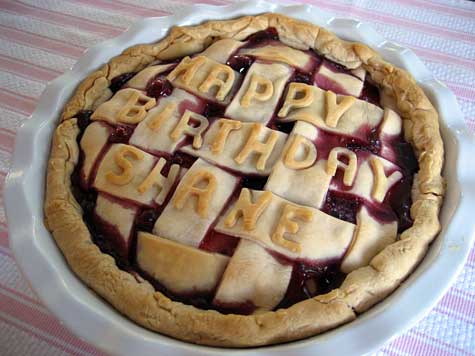
Suna’s birthday is this Saturday. So I’ve been thinking a lot about birthdays.
This is a list of Table Topics questions I used at today’s Toastmasters meeting. Rather than having volunteers choose a number, I just picked a topic for them, including (jokingly) asking the guy I know never watches movies, “What’s your favorite birthday movie?”

Here is the text of the speech I delivered today at Toastmasters. It is a bit of a ramble because I procrastinated and didn’t have time to apply sound instructional design to it. I also tried a physical ending, which confused at least one member of my audience.
The speech ran a little long, so I’ve marked some of the text for removal if I ever deliver it again.
Mark Twain may have said it best. “There are three types of liars: liars, damned liars, and statisticians.” In his 1952 classic,
Elementary Statistical Analysis , Harry Hartkemeier says Twain implies that statisticians “have reached the superlative.” There is no better liar than a statistician.But as much as we distrust statisticians, we all love to bandy numbers to support our points. I’ve heard that as much as 67.8% of all statistics are made up on the spot.
We love numbers, but we believe them only when they support our views. Why is that?
Have you ever deliberately falsified the numbers to support your claims?
Do you know someone who has?
Yes, we’ve all read about sloppy scientists who have [falsified the data]. We may know someone who has. We may even have done so occasionally ourselves, as with my reference to the percentage of impromptu statistics. Actually, less than half of all statistics are made up.
So why don’t we trust statistics?
- They don’t seem to yield any useful information.
- They are often contradictory.
- They’re almost always confusing.
Like many on the right, I blame the liberal media. And like many on the left, I blame Fox News.
The media has become fixated on numbers. Statistics make sloppy reporting sound more credible. And in the drive for audience, they focus on one type of statistics above all others—relative statistics.
Now you won’t be able to find a textbook on relative statistics. It isn’t a real branch of the actual science. That comprises:
- Descriptive statistics, which summarizes data by describing what was observed in a sample
- Inferential statistics, which uses patterns in the sample data to draw inferences about the data
Inferential statistics is most often used in scientific research looking for a correlation between two variables.
And that’s where we begin to get into trouble. The first problem is that people unfamiliar with the scientific method confuse correlation and cause even though the first thing you lean in Intro to Statistics is that correlation does not equate to cause. Correlation does not equate to cause.
Early in the century, two separately reported studies told us that people who drink more than four cups of coffee every day have:
- A 40% increased risk of colon cancer
- A 40% decreased risk of heart disease
Sounds like a wash, right?
But increased and decreased risk are relative statistics. Even saying that something increases your risk of dying by 100% doesn’t give you enough information to make an informed decision.
- If choosing one behavior over another increases your risk from 1/1B to 2/1B, that is a 100% increase—but not much of a risk.
- If it increases your risk from 1/1000 to 1/500, it’s still a 100% increase. And it poses a much more immediate risk.
- But even in the second case choose one behavior or the other won’t ensure you to live or die.
Another way relative statistics causes problems is that the media may only report one side of the equation. NaturalNews.com reports on a study in
Archives of Pediatrics & Adolescent Medicine saying that women who take antibiotics during pregnancy are significantly more likely to deliver babies with birth defects than those who don’t.
- Mothers of children with a fatal skull and brain malformation were three times more likely to have taken a sulfa drug than women whose children did not have the defect.
- Kids with cleft lips or palates were twice when mothers had taken nitrofurantoins, which were also linked to congenital heart defects, eye defects, and being born missing one or both eyes.
- Penicillin was associated with a higher risk of a kind of limb malformation.
The report fails to mention what these women were being treated for. We have no information about whether the conditions the women had could have similarly damage or even killed the fetuses. We do know that if the disease had killed the mother, the baby would not have had a birth defect.
The media loves to report relative risk because phrases like “100% increased risk” or “three times more likely” or “half as likely” get your heart going. They scare you. They make you want to pay attention to what the reporter says.
And about coffee: it turns out coffee may reduce the risk of colon cancer by speeding the passage of carcinogens through your gut. Web MD says the decreased risk of heart disease ranges between 19%–91%—no descriptive statistics there.
But it does explain the mechanism of the reduction: antioxidants and anti—inflammatory compounds in the brew.
So the next time you hear about relative risk, know that the information is probably reliable but useless. Hearing the numbers should start your research, not make up your mind. It’s up to you to find out what the numbers really mean.
Oh, and now they say coffee also reduces your risk of Type 2 Diabetes. Who cares if the statistics are only relative? I’m going for another cup!
Not one of my best efforts. Maybe I’d give it a B.

Here is another of my speeches for Toastmasters. It is Speech Six from the Competent Communicators manual, Vocal Variety. I delivered it today.
I’ll warn you up front, this is a bit of a ramble. Memories tend to be. They all blend together over time, especially the important ones, forming a gentle patina.
Even though she had to quit high school and go to work when her parents died within six months of each other, my mom was one of the smartest people I’ve ever known. She was also one of the funniest, but you’d never know that by the jokes she told. Let me give an example:
Two painters were going though the countryside painting churches. Even though it was the Depression and they didn’t have a lot other than each other’s company, the never went hungry. But being people, they wanted more.
One day one of them said to his partner, “You know. If we thinned the paint, we could paint twice as many churches for the same cost. We’d make a lot more money.”
“We sure would,” Partner said. “Let’s do it.”
So the next church they painted, they thinned the paint. They were just finishing up and thinking about how much money they’d make when a thunderstorm blew up. The thunder crashed, the wind blew the rain sideways, and the storm washed all of the thinned paint off the building.
Looking at the havoc the storm had wrought on their work, they were devastated. “What are we gonna do now?” they moaned.
A voice from the clouds advised, “Repaint and thin no more.”
Mom’s sense of humor was gentle and consistent.
She had this one necklace that had these two huge gold-painted balls dangling from a string of plastic pearls. I heard her cry out from the kitchen one day. I rushed to see what was wrong. “Oh, it’s nothing,” she said. “I just closed the oven door on my balls.”
Now there’s a visual that will give a teenage boy nightmares.
How do I know she was smart? Other than my dad, I admired two men who respected her.
Mr. Morrison, ran a construction company and owned several banks.1 He helped convince Lloyd Bentsen, the senator for whom much of US-59 is named, to go into politics. When the salt dome in Louisiana caught fire in the mid 1970s, Mr. Morrison called Senator Benson. “Lloyd,” he said. “It’s just like our goddamn government. First, they buy up all the oil, driving up the price so nobody can afford to drive.2 Then they put in back in the ground where we’ll never get all back out. And now they’ve set the sonuvabitch on fire,” he exclaimed slamming the phone back on the hook. We used to take bets on how many times it would bounce before it fell off his desk. That time it bounced three times before crashing onto the worn linoleum floor.
Mr. Morrison didn’t mince words. He fired his building superintendent three times one day. Then called him up the next morning and cussed him out for not showing up for work.
Mom was his sales manager. She was the person he consulted when buying or selling houses for more than a decade.
That’s one way I know she was smart. The way I know was my grandfather.
Granddaddy was a typical early-20th century German farmer. He defined chauvinism. When he was ready to retire, he called the family together to get advice on what to do with the farm. My dad and uncle Carole started to say something, but Granddaddy cut them off with a flick of his hand. “I don’t care vat you say. I vant to know vat Kay sinks I should do.”
This August marked the 10th anniversary of her death.
I still miss you, Mom.
But rather than closing on a down note, here’s another one of her favorites:
A cop pulled a man over for not signaling a left turn.
“But I did signal,” the man protested.
“No, you didn’t.”
“Yes, I did,” the man insisted. “Just ask my wife. She was sitting right here beside me. She saw me signal.”
“Well, ma’am” the cop said. “Did he signal?”
“Well, officer. If I’ve learned anything in 40 years of being married to that man, it’s never to argue with him when he’s drunk.”

Until I read Abraham Lincoln: Vampire Hunter, I hadn’t realized how much the readability of Seth Grahame-Smith’s previous book, Pride and Prejudice and Zombies, was derived from the original. While I admired the near seamless integration of zombies into Alcott’s social commentary, I considered the result more of a collaboration than an outright theft.
In
Character development is lacking. Who would have thought anyone could depict Abe Lincoln as a flat, uninspiring character. If that was Grahame-Smith’s intent, he succeeded.
One of the best things I can say about the book is that I found no glaring grammatical errors and no blatant historical inaccuracies. Aside from vampires, and they are a given.
I can’t say if this is a good thing or not, but I was completely unable to categorize
None of this is to say you shouldn’t read
Using a five-star scale,
Today’s post is the text of a speech I delivered at Toastmasters today. I hope you enjoy it.
A word can mean so many things – anything, everything, or nothing. We argue over the meaning of words incessantly. Nobody wins.
Today, I’m going to talk about the intersection of semantics and lexicology – that lonely place where meaning lives.
Don’t be scared. That’s almost all the linguistic jargon I’m going to use.
Jargon is one of my favorite words. It comes from a French word that means “the twittering of birds.” In what John Ciardi, one of my favorite etymologists, would call “ghost etymology” (a word history somebody made up because it sounds good), I once read jargon comes from jargere, which the writer said means “to make a choking, strangling noise at the back of your throat.” I wish I could verify that particular meaning.
Every profession or clique has its own jargon — its own theives cant — designed as much to streamline communication within the group as to occult it from outsiders.
Instead of jargon, nomenclature, or whatever, I’m going to tell a story I like to call “The Lion’s Share of Meaning.”
But before I get to that, let me ask you a question.
Is it more important to be understood or to be right?
Robert Heinlein said, “If you’re arguing with your spouse, and it turns out you’re right, apologize immediately.” He also said, “You can be forgiven for being wrong a lot faster than for being right.”
Have you ever heard an argument so rabid as one between two people who agree with one another but use different words to state their points? Not unless it was one that arose from a broken understanding when people used the same words to mean different things.
These are often the arguments that lead to irreconcilable hurt feelings, to the dissolution of friendships, to violence.
Pride and Words are at the heart of these arguments. We seem to have an unquenchable need to be right. Sometimes it’s easier to say someone else is wrong than to prove we’re right.
And that calls into question the meaning of being right. What does it mean to be right?
The story that comprises the lion’s share of my speech comes from Aesop via John Ciardi.
What does “the lion’s share” mean?
Here’s how it started:
The lion organized a hunting party. After the party made the kill, the lion stepped up to the carcass and said, “As the King of Beasts and organizer of this hunt, I deserve half of the kill.”
The other animals grudgingly admitted that was the lion’s right. So does “the lion’s share” mean half?
No. As the other animals closed in, the lion raised his voice. “And my wife and children deserve half of what remains because they are my family.” Again, the rest of the hunters conceded the right of the lion’s family to another quarter of the carcass. So does “the lion’s share” mean three-quarters?
Not really. As the hungry hunters hunkered closer to the carcass, the lion said, “And I’ll fight anyone who wants any of the remainder.”
So “the lion’s share” doesn’t mean half or most or three-fourths. It means the lion wants it all. But if you use the phrase correctly, nobody will know what you mean. As John Ciardi advises, “Never be so right as to be misunderstood.”
It’s more important to be understood than to be right. It’s more important to understand what each other’s words really mean. Sometimes you may find, you agree.

Suna and I planned a trip back to see some of my family this weekend. Unfortunately, life intervened in a minor way. Suna had a conference where she could see some of her old friends, and I had a leadership training session with Toastmasters Saturday morning. All that means we left about 16:00 for a four-hour trip to Brazosport.
Since we had plenty of daylight this soon after the Solstice, I decided to show Suna the little town where I lived my first four years of elementary school, Brazoria. I needn’t have bothered. I didn’t recognize anything about the town. Even the old school was missing. I could have been on Mars for what I knew about my home town.

Feeling a little odd, we went on to the hotel and checked in. From the room, we could see a flare at Plant B, part of the huge petrochemical installation that forms the heart of the Brazosport economy. That and the smell of hydrocarbons in the air made me feel like I was home again—and remember why I left. Although in the name of full disclosure, I must admit I do hold Dow Chemical stock.
After looking out the window and unpacking, we decided to get a bite to eat. We went looking for seafood, but the closest place was closed.

Right across from it was El Toro, a TexMex café we used to eat at when I was a kid. Like Brazoria, El Toro was nothing like I remembered. It has a full bar, great margaritas, and about three times the seating capacity. There is even a painting of Superman flying across the ceiling. About the only thing that is the same is that the food is every bit as good as I remembered. The portions are a little smaller, but that is a good thing.

By the time we finished eating and got back to the hotel, it was almost 22:00, and we were tireder than we expected.
We lazed in bed for a while this morning before heading to Angleton to visit my nephew, his daughter who was visiting from California, and her new baby, my great-great-nephew. How can that be? I’m not that old.

Anyway, Suna wanted eggs for lunch, and my brother Jim recommended the Hometown Café. It doesn’t look like much from the outside. Really, it doesn’t look like much from the inside either. But the food is decent, the prices are good, and the service is friendly.
We finally arrived at my nephew’s house about 13:30—roughly 3-½ hours early—to find the party well under way. We chatted. We played a variant of bocce ball. We tried to stay dry and in the shade. We had a really good time. We ate some more. We visited.
Finally, we headed home. And here I am again—tireder than expected.


