Saturday, February 27, 2016

Starting the Journey to Freedom

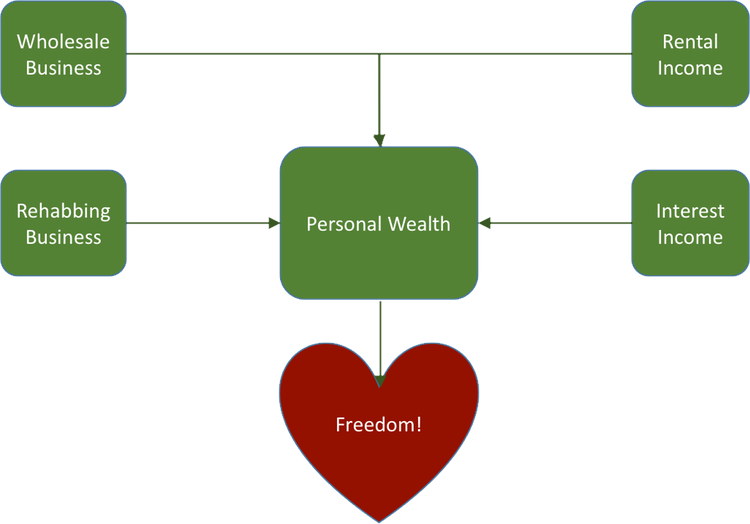
A very complex graphic A balanced approach to investing can help you achieve the goal of personal freedom—whatever that means to you.
This post originally appeared on the Hermit Haus Redevelopment website on 2016-02-25.

I’ve gotten several questions about the cash flow diagram in my last post, so I’m going to explain it in detail today.

First, if you haven’t already read Robert Kiyosaki’s short book Rich Dad, Poor Dad, I highly recommend it. I even bought copies for many of my friends and team members. It’s a short read, but it packs a lot of financial intelligence in amongst its folksy yarn. It’s not biography (or necessarily factual), but the fictive stories illustrate his points.

Kiyosaki categorizes income into two income families, each of which comprise two types of people:

Robert Kyosaki in front of his cash flow quadrants. Kiyosaki’s Quadrants
Active Income
  • Employees (E) have a job and work for someone else.
  • Self-employed persons (S) have a job but work for them selves.
Passive Income
  • Business owners (B) have a system that employs other people’s time, energy, and intelligence to generate income without requiring the business owner’s direct input.
  • Investors (I) put their money to work to make more money.

If you look closely at these two graphics, you’ll see how they align. Real estate wholesaling and redevelopment are essentially forms of employment or self-employment. If you don’t work at them, the income goes away. Rental and interest income are more passive, but managing rental properties can become a jobby-job. Ask me how I know.

That said, you could turn your active businesses more passive by employing enough people to minimize your active effort in them. That’s the goal, isn’t it?—to have the business create the income you use to buy your way out of it.

These are lessons I’m still working on. It’s very easy for me to get down into the weeds of my investments until managing them takes so much time I’m not creating new opportunities. Moving from the left side of the graphics to the right requires a real shift in mindset. It requires stepping away from the illusion of security into the security that comes from understanding how money works and how to make it work for you. That’s not an easy transition, but at least I can see where I’m going.

The goal of any income stream should be wealth creation. Wealth eventually becomes self-sustaining, unless you gamble it away or try to live above the means it provides. When wealth becomes self-sustaining you have achieved a goal most of us only dream of: freedom.


Monday, February 22, 2016

Balanced Investing in Real Estate

Me, me, me, and some famous people I address a group of investors with Ryan Connell of Grand Coast Capital and Paul Esajian of FortuneBuilders.
This post originally appeared on the Hermit Haus Redevelopment website on 2016-02-20.

We are attending a real estate investing convention hosted by FortuneBuilders this week. Anyone who has ever an event like this knows that you are running from the time you wake up in the morning until the time you fall into your hotel bed at night. There is so much to learn and so many people to meet!

And the people are the best part of it. I met another investor who lives in Milam County, where our ranch is and where we hope to retire someday. Isn’t it ironic that I had to travel to a convention to meet a neighbor with whom I have so much in common?

But the highlight for me was being asked to address a group of fellow investors about investment strategies and how you can be fully invested in various aspects of the real estate economy and still have a comfortable degree of diversification. I hadn’t spoken in public since I left the corporate world a few years ago, and this crowd was the largest I have stood in front of since I left rock and roll behind in the 1980s. Being asked to explain your investment strategies to a crowd of more than 300 fellow investors is very exhilarating and very humbling.

A very complex graphic A balanced approach to investing can help you achieve the goal of personal freedom—whatever that means to you.

My points echoed the advice of all my mentors:

  • Wholesaling and redeveloping properties should only be one part of your overall strategy. These activities have the highest reward, but that means they also have the highest risk.
  • A rental portfolio can help you build real wealth over the long haul, but it is also not without risk.
  • Putting your money to work by buying into or investing with a hard money lender can generate moderate income while spreading the risk over a much broader pool than lending on a case-by-case basis, but the returns can be lower.

For the last point, I have a considerable chunk of my investment portfolio in Grand Coast Capital, but I still engage in private money lending. While I intend to increase my Grand Coast investment over time for a more certain return I still enjoy helping my fellow local investors achieve their goals when I have free capital to invest with them.

JP Getty once said that the best way to get rich is to help others get rich. Not only is helping others efficacious, it is the most rewarding path. Helping others is not just part of our mission statement at Hermit Haus Redevelopment, it is our core value.

So I would be remiss in my helpfulness if I failed to include this caveat: Nothing you do in the investment game is without risk. As my dad used to say, “If it was easy, everyone would do it.” What he didn’t say was that if it was easy (or risk-free), there wouldn’t be any profit in it.


Saturday, February 06, 2016

Cloudy Title

I borrowed this picture from a WUNC article on bank robbery. It seemed appropriate to use it in a discussion of robber banks. We found out about a bogus $14,000 lien against one of our rentals today. Bogus liens are a multi-million dollar industry. Photo by: WUNC
This post originally appeared on the Hermit Haus Redevelopment website on 2016-02-04.

It is ridiculously easy to put a lien on someone’s property in Texas.

This morning I was talking to our banker at First Texas Bank about a Home Equity Line of Credit (HELoC) we are in the process of taking out in the company name using a house Suna and I own free and clear. This is a strategy to help build credit in the Hermit Haus name. The company is responsible for paying back the loan, but Suna and I are still on the hook. It’s like cosigning for your kid’s car.

During that call, I found out that a bank put a lien on our Lloydminister property—the one we own free and clear—in the name of Susan Kendall and her husband. The bogus lien is for roughly $14,000. That’s no pittance in anybody’s book.

Apparently, having a name that sounds like someone else is good enough. Someone at that bank decided that Susan Kendall must be the same person as Sue Ann Kendall and filed a lien on our property. Texas has no mechanism to check the legitimacy of these liens. The state blithely assumes that anyone filing such a lien must be correct and homeowners are guilty until proven innocent.

I have known about the possibility of these bogus liens for years, but I have never encountered one before. In checking with a couple of Realtors, I was told situations like this one happen “all the time.” The problem apparently amounts to millions of dollars each year in legalized fraud or robbery, depending on how you want to look at it. The good news is that the lien holder can’t force us into foreclosure. They have to wait until we find out about their scheme or sell the property.

Many people don’t find out about one of these bogus liens until they have a contract to sell their property. Then they are under too much time pressure to fight the fraud and end up paying for someone else’s debt just to be able to sell their own property. But on the positive side, it’s the title company’s job to clear these things up, and, given time, they are pretty good about clearing them up.

Luckily we found out with time to fight. Keep following this series to learn more as I do.


Friday, February 05, 2016

Communication Is Key

Front of the house The siding is up on the kitchen bump out.
This post originally appeared on the Hermit Haus Redevelopment website on 2016-02-03.

The Blue Ridge project is still running behind schedule, and there were a couple of developments that will put it farther over its budget this week.

First the good news: the cabinets and countertops are in in the kitchen and both bathrooms. The granite countertops really pop against the white cabinets, which are not quite Shaker style. We even had the folding table in the laundry room topped with the granite.

And the siding is up on the kitchen bump out—the one where we had to remove the brick facade last week. Part of it got knocked down, and it was safer to remove the rest of the brick than to repair the remainder. The horizontal HardiePlanks echo the siding on the other three sides of the house. It looks good, even in the weird default primer color. It will look even better painted to match the house.

That brings us to the bad news and the title of this post. Last week, we messaged the contractor, Chris, a picture of the color fan showing the color we wanted matched against a wall. The contractor asked if we were sure, and we responded that we were without really understanding what he was asking. The problem is that each blade of the color fan has a range of shades of the color ranging from very pale to dark. We had used the lightest at a different house, and that one had a note written on it. Chris thought we wanted the color with the note, and we thought he would understand we wanted the one that matched the background against which we took the picture of the color fan blade. Neither of us actually mentioned the name or color code.

So when I showed up to inspect the property today, I asked in all innocence if they had just sprayed the house with primer. “No. That’s the actual color you guys chose.” Argh! The whole exterior of the house is the wrong color. So we get to buy more paint and pay to repaint the house: More money over budget and more time lost!

The bottom line is this: when you are talking with your contractors (or human beings in general), be as specific as you can. If you’re talking about paint, talk color codes and names. It’s an easy mistake to make and a difficult lesson to learn—again. Get Sue Ann to tell you about the time I had her house painted orange.


Wednesday, February 03, 2016

Taxes

Bitmoji cartoon of me getting a tooth knocked out Taxes hurt, especially when you can’t plan for them. Photo source: Bitmoji
Let me tell you how it will be
There’s one for you, nineteen for me
‘Cause I’m the taxman, yeah, I’m the taxman

George Harrison

I got a property tax bill in the mail today from DeWitt County for the Yorktown farm. Property taxes in Texas are usually due by the end of January. This is February. Surprise!!

Without going into too much detail, let me just say that the bill is well into the five digit range. And because they would normally have been due a few days ago, I just took advantage of an investment opportunity, so I don’t have that kind of free capital. I don’t like to let my money be anywhere near as lazy as I am. I want it to work for me.

Theodora on her broom “I’ll get you…and your little dog, too. You’ve got to pay your taxes. Pay! Pay!” Photo source: Villains Wikia

There are a couple of bright spots on this dung heap. First, the county admits they were late getting the tax bills out (because they were “understaffed,” they said—whose fault is that?). Because of that, they are allowing until the 27th to pay the taxes “without penalty.” That would be nice if people (other than my dad) left that kind of money lying fallow in a moldy bank account somewhere. Now I have to find it.

The real bright spot is that I “paid myself first,” as Robert Kiyosaki puts it. I put my money to work in an investment that will earn far more than the penalties I’ll incur for paying the property tax late. And since there are a half dozen separate bills, I can string the county out paying them off over time as more money come is.

This situation worked out much better than if I had paid the taxes before the opportunity came along.


Monday, January 25, 2016

Paying Contractors

Paint supplies and a painted wall We have paint and texture on all drywall at Blue Ridge, but we seem to have lost a week in the process somewhere.
This post originally appeared on the Hermit Haus Redevelopment website on 2016-01-23.

The Blue Ridge project is taking longer than expected. Don’t they all? But the texture is on the walls and painting has commenced.

As best I can tell, we are about a week behind schedule without having encountered any serious delays, just a series of small ones. But, as with pennies, small delays add up.

This situation is an example of why you should pay your contractors on completion of tasks, not on a time-based schedule—no matter how good they are or how much you trust them. Unfortunately, we agreed to weekly payments on this project, mainly because we had too much going on, had our primary contractor back out of bidding because of too much work already booked, and urgent relief at having found a recommended GC who was willing to start two weeks earlier than anyone else. Not to mention the distractions of the Christmas season.

All of that now leaves us in a situation where we have to renegotiate the payment schedule at the end of the project.

When you pay on task completion, you risk having your project become a lower priority than “more lucrative” projects. On the other hand, paying on completion guarantees you won’t be paying for undone work, but it doesnt guarantee timely completion. Either way, delays increase your holding costs during a project.

Here are some lessons we’ve learned over time:

  • Have your contract written so you pay on completion of a task rather than on a schedule.
  • If the contractor is furnishing the materials, keep the upfront payments minimal, but reasonable.
  • Keep tabs on the work as it progresses, and don’t be shy about asking questions.
  • Always plan on paying at least 10% more than the bid. There will always be things you didn’t know about when the project went out for bid.
  • Plan for at least six weeks of holding costs beyond the scope of the project. There are almost always delays in the renovation and sale processes.
  • If you plan for a longer, more expensive project, you’re in good shape if it comes in on time and on schedule. The inverse is not true.


Friday, January 22, 2016

Construction Update: The Value of a Dumpster

Villa Park is a mess. The nanny suite has been skinned with hardiplank, but its emerging beauty is hidden by debris. Blue Ridge is much neater thanks to a dumpster. Thanks to the dumpster, Blue Ridge looks inviting, even in the middle of the renovation.
This post originally appeared on the Hermit Haus Redevelopment website on 2016-01-18.

This post started out to be a quick update on the two renovation projects we currently have running, but you know me: I can’t resist wagging my tongue when something finally sinks in. So, I’m going to preach (probably to the choir) about dumpsters first, and give a short update at the end.

Many rehabbers use dumpsters at their projects—certainly all of the ones you see on television. But others let the refuse pile up or pile it onto trailers to take to the dump when they are ready. The GC I have used for the last eight years falls into the later camp. “Why pay the money for a dumpster when I can haul stuff away much cheaper?” he asked the first time I suggested getting one. Not being intimate with that part of the business, his logic swayed me. He is handling the Villa Park project.

We decided to use a dumpster at the Blue Ridge project as we brought on a new GC who actually preferred renting a dumpster. The photos at the right show the difference between the two projects, both run by professional contractors who are very good at what they do.

I won’t compare overall costs, because the two projects are radically different and have produce dramatically differing qualities of debris. But priced by the yard, the dumpster method seems to win out, even in cost. Thirty yards of debris cost roughly $500 to dispose of at Blue Ridge. The same amount of debris cost about $450 to dispose of at Villa Park. So I saved $50 by having my GC haul off the waste. But take another look at the two pictures.

Now here are some hidden costs of having your GC dispose of the construction debris:

Lost work
Your crews aren’t making progress on your project when they are at the dump.
Neighborhood respect
While I haven’t received a single complaint about the debris at Villa Park, I haven’t had a single neighbor inquire about what we do and if we can help them. We have had a stream of neighbors at Blue Ridge wanting to see the project, and several talked about friends whom we might be able to help.
Workplace safety and productivity.
None of the crew on any of my projects has ever reported an injury. That said, I can’t help but believe piles of trash around a project have to decrease productivity as workers carefully negotiate the paths they have left.
Pride
While I am proud of the work we’re doing at both projects, and I know I will be extremely proud of the final products, I am ashamed of going to the Villa Park project now that I have seen a well maintained workplace at Blue Ridge. I believe the workplace conditions will also affect the pride of craftsmanship in the workers, too.

I am now an advocate. We are ordering dumpsters for the Villa Park project, and I have made a convincing economic argument to that contractor in favor of them.

Villa Park Update

We have now passed all inspections and are moving forward with finishing out the walls. The skylight has been removed and roofed over. It wasn’t leaking, but they eventually do.

Blue Ridge Update

All walls inside the house have been refloated after removing the popcorn. We lost a day because someone turned off the heat, and the drywall compound didn’t dry overnight. We should be ready to paint early next week, and the flooring will go in shortly thereafter.

Thursday, January 21, 2016

Streams of Income from Rental Properties: Equity Growth—Infinity and Beyond

Buzz Buzz Lightyear should be every real estate investor’s hero. He had the right motto.
This post originally appeared on the Hermit Haus Redevelopment website on 2016-01-19.

So far, we’ve talked about the most obvious stream of rental income (cash flow) and the less obvious concept of viewing depreciation as income through tax reduction. Today, I want to talk about equity growth.

As you continue to make monthly mortgage payments, your equity in the property grows. But remember, you are not making the payments. Your renter is. So that equity growth represents a very real increase in your wealth, and you don’t have to do anything to get it except keep your rental property in rentable condition and rented.

Before we get started today, I want to be clear that I am making some unreasonable assumptions in this discussion. I make these assumptions because I want to talk about making money on borrowed money, and clouding that concept with other issues makes that concept much more difficult to understand. We’ve all been taught for years that debt is bad, but Robert Kiyosaki points out that there is good debt and bad debt. I’m talking about good debt. So here are my assumptions:

You are only breaking even every year for the duration of a thirty year mortgage.
Chances are you’ll make more than enough money to cover all of the expenses of owning a rental property and put money in your pocket besides. So for the purposes of this discussion of good debt, we’ll assume you neither make nor lose money but that your cash flow remains completely neutral with regard to your mortgage payment.
Your rental stays occupied 100% of the time.
This is the only assumption I believe is totally bogus. You will have downtime in your rental income stream. But over time, your cash flow from the property should be more than sufficient to cover all the payments.
There is no such thing as inflation.
As you’ll see in the next post in this series, inflation will ensure you make more money the longer you hold the house, even if you start out with negative cash flow. But for this discussion, your rental will neither depreciate nor appreciate. Taxes and insurance will remain as fixed as your interest rate, and along with maintenance, they will be irrelevant. Another way to visualize this assumption is to think of all your maintenance costs being wrapped into your mortgage payment.

So here’s the deal:

Even if you only break even on your monthly payments, your rental property will increase your wealth from day one.
GraphThe chart says it all. The golden bars are the balance you owe on the rental. It goes down over time. The blue bars represent your equity in the house, and it goes up as your tenants make your payments. The green line is your return on the $25,000 cash you invested to buy the rental.

That increase in wealth only becomes taxable when you sell. If you die, your heirs’ basis is the value of the property at the time of your death, so the increase essentially is invisible from a tax perspective—assuming your estate is worth less than about $5.4-million today, or whatever the threshold for the estate tax is at that distant point in the future. Even then, the value of the estate is taxed, not the value of the individual properties that comprise it.

That’s right. If you later refinance the rental to get your $25,000 investment out of it, your tenants continue to make your payments and you have an infinite return on investment. If you refinance enough out of this property to pocket your $25,000 (but why would you) and buy another rental, you’ve essentially doubled your infinite return. You’ve done what Buzz Lightyear only talked about; you gone to “Infinity and Beyond!”


Posts in this series:

  1. Streams of Income from Rental Properties
  2. The Two Examples and Cash Flow
  3. Tax Reduction Through Depreciation
  4. Equity Growth

Tuesday, January 19, 2016

Good Company

Brody and Harvey sitting in a window This isn’t a very good picture, but it shows the boys in one of their favorite office activities: pretending to be cats sitting in a window.

I spend a lot of time working in my “office,” which is really a room in the garage I originally intended to use as a woodshop. Brody and Harvey keep me company even though I’m sure they’re bored. They still like hanging out with me.

Wednesday, January 13, 2016

We Learned Stuff

I have a blue shirt. Even though the slide I’m looking at is nearly blank, I did take good notes throughout the weekend. Photo by: Sue Ann
Sue Ann has her own comments on this seminar on the Hermit Haus Redevelopment website today.

As a long-time instructional designer in the corporate world, I appreciate good training. But the truth is, you can even learn something for poorly-designed training. This weekend seminar on marketing strategies wasn’t the best designed training I’ve ever seen, but it did have lots of good information. A passionate trainer helped.

My big take-aways include:

  • Marketing takes time to be effective. Keep throwing good money after…it.
  • While most mail campaigns can start to familiarize recipients with the sending business after four or five contacts, marketing to a probate list can take more than nine or ten contacts.
  • People will respond more favorably to mail marketing from a female name than a male one. Really?
  • The presenter has had good results from outbound calling. Again, really?
  • “But what about the dog?”